
Best Bentley Body Shop in Dubai
If you are searching for the best Bentley body shop in Dubai, you want a workshop that treats depth, flatness and fit as the standard, not the upgrade. We repair and refinish Continental GT, Flying Spur, Bentayga and Mulsanne bodywork for owners who expect the panel to disappear back into the car.
What a Bentley-standard finish actually means
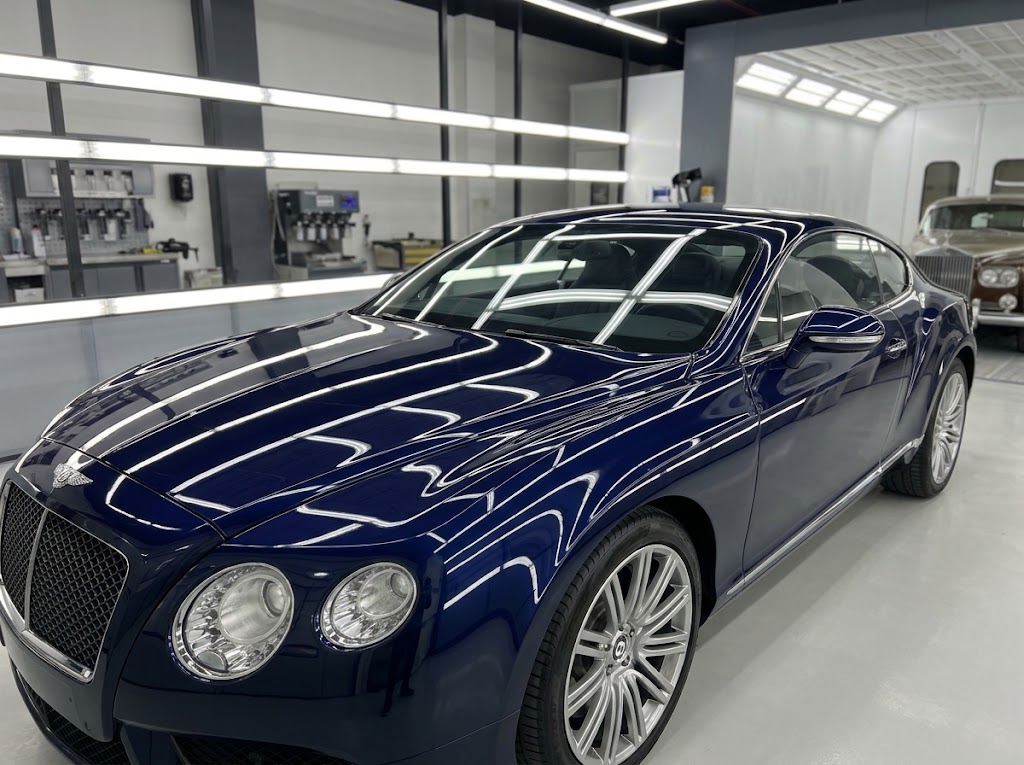
A Bentley finish is judged in reflections. Stand at the front wing of a Continental GT and look down the flank: a straight line, such as a building edge or a strip light, should run the full length of the car without bending, breaking or going soft at the edges. That is the test owners apply, often without realising it.
Factory Bentley paint is built for that test. The colour sits beneath a generous clear layer that has been flattened and polished to a near-mirror surface, so the eye reads depth rather than texture. A repaired panel has to match three things at once: colour, depth of gloss and flatness.
Most body shops can get close on colour. On a Bentley, the difference is made after the paint has cured, and in how the edges, trim and panel gaps around the repair are treated.
- Colour from the code, not the eye. We read the factory paint code, mix to it and confirm it on spray-out test cards in daylight and booth light before a panel is painted.
- Gloss that matches its neighbours. A repaired door must look as deep as the untouched wing beside it, from every angle.
- A flat surface. Texture in the clear coat, often called orange peel, is taken down so reflections stay sharp.
- Clean edges. Chrome, seals and badges are removed or protected so there are no hard tape lines or overspray.
Bentley models we repair
We work on the current and recent Bentley range seen on Dubai roads, from daily-driven Bentaygas to weekend Continentals. Each model has its own panels, materials and trim, and each shapes how a repair is planned.
Continental GT and GTC
The coupé and convertible carry long flanks and superformed aluminium front wings on recent generations. Continental GT body repair centres on keeping those crisp lines straight, and on the GTC the fabric hood stays fully protected.
Flying Spur
The four-door saloon has a long roofline, a large bonnet and generous chrome, including window surrounds and the retractable Flying B mascot on recent cars. Every bright detail is removed or masked before preparation begins.
Bentayga
The SUV sees the hardest use in Dubai: kerbs, car-park ramps and sand on the lower panels. Bentayga paint repair often covers bumpers, sills and arch edges, and duotone specifications need a perfectly placed colour break.
Mulsanne
The older flagship is a large, hand-finished saloon with broad flat panels that show every flaw. We take on Mulsanne repairs with extra care around its heavy chrome and the age of its original paint.
Send photos of the damage first
A few clear photos taken in daylight let us explain what the repair involves and how long your Bentley will be with us.
How do you match the depth of Bentley paint?
Depth is not a single coat. It comes from how the layers are built: a sound, level primer surface, a colour coat laid evenly with no clouding in metallic or pearl finishes, then clear coat applied with enough film build to be cut back later without breaking through.
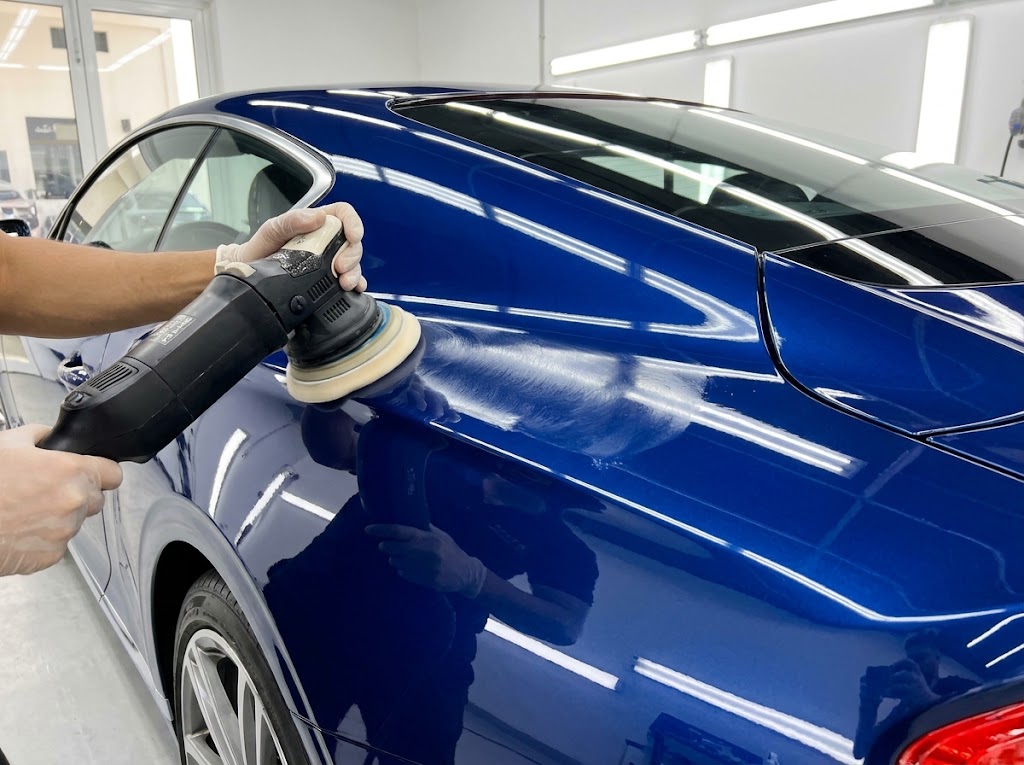
That last point matters. Bentley-grade gloss is rarely achieved straight from the spray gun. The clear coat is left to cure fully under controlled booth conditions, then flatted by hand and machine finished in stages until its texture matches the factory panels around it.
We check paint depth with a gauge before and after the work, on the repaired panel and on its neighbours. That shows how much material the factory applied, how much any earlier polishing has removed, and how far a new finish can safely be refined.
Flatness is checked the way an owner would check it: under straight light bars, from low angles and from a distance. If a reflection bends where the repair meets original paint, the panel is not finished.
The table below shows how each element of the finish is handled on a Bentley.
| Finish element | Why it matters on a Bentley | How we handle it |
|---|---|---|
| Base colour | Bentley colours often carry dense metallic or pearl effects that shift with the viewing angle. | Mixed from the factory code, proven on spray-out cards and blended into adjacent panels where needed. |
| Clear coat depth | Depth gives the paint its liquid, three-dimensional look. | Applied with enough film build to allow cutting, and measured with a paint-depth gauge before and after. |
| Final cut & polish | The factory surface is near-mirror flat, so untreated clear coat shows texture beside it. | Flatted and machine finished in stages after full cure, then checked under straight light. |
| Duotone line | A wavering or soft colour break is visible from metres away. | Set from the original line, masked with fine-line tape and checked for symmetry side to side. |
| Chrome/bright-ware | Tape edges against chrome leave hard lines and stepped paint. | Removed and refitted wherever practical, with fine masking only where removal is not advisable. |
| Superformed panels | Aluminium wings formed in one piece hold sharp, deep shapes that steel methods can distort. | Repaired with aluminium-specific tools, keeping the original panel wherever its shape can be restored. |
Duotone, Mulliner and bespoke colours
Bentley's colour palette is unusually wide, and Mulliner, the company's personalisation division, extends it further with special colours, duotone schemes and coachlines specified by individual owners. Many cars in Dubai carry a specification that does not appear on a standard colour chart.
Bentley duotone paint splits the body into two colours along a defined line, usually following a crease or the waistline. When a duotone panel is repaired, the line has to return exactly where it was, at the same height and sharpness, and match the opposite side of the car.
We start by reading the paint code from the car itself. For Mulliner and bespoke colours, the code is the starting point rather than the answer: spray-out cards are compared with the car in daylight, and the mix is adjusted until the card disappears against the original panel.
Where a colour cannot be matched perfectly within one panel, we blend into the adjacent panels so the eye has no edge to find. We will tell you before we start if a blend is needed and which panels it will touch.
Our Bentley repair process
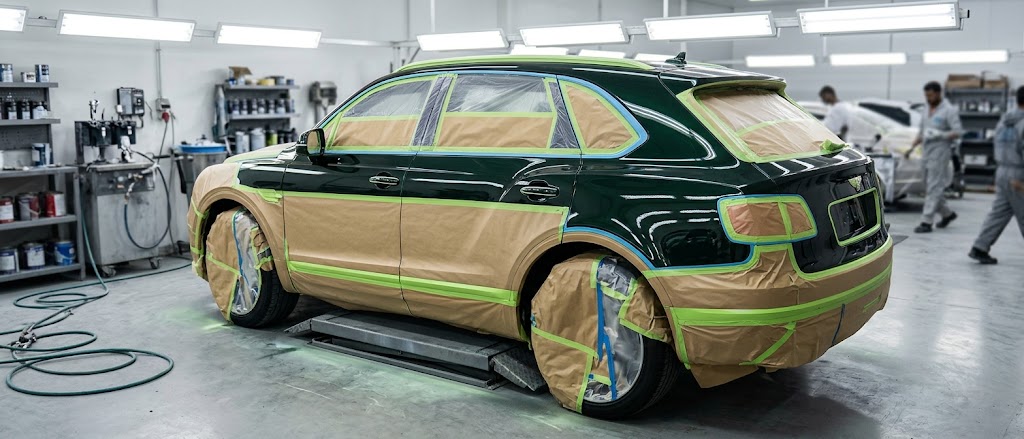
Every repair follows the same six stages. The order matters: most problems in high-end refinishing are prevented early rather than corrected late.
Photos and inspection
It starts with your photos on WhatsApp, then an in-person inspection. We measure paint depth across the damaged and surrounding panels, note previous repairs and confirm the paint code and any duotone or Mulliner details.
Bright-ware and badge removal
Chrome trims, window surrounds, badges, lamps and handles are removed where practical, labelled and stored for refit. Parking sensors and cameras in the bumpers are masked or removed so they are not coated or disturbed.
Body and aluminium repair
Dents and creases are corrected on the original panel wherever its shape allows. Aluminium panels, including superformed wings, are worked with dedicated aluminium tools to avoid contamination and stretching. The aim is a correct shape before any filler is considered.
Preparation and colour
The panel is prepared to a level primer surface. The colour is mixed from the factory code, proven on spray-out cards against the car, and blended into neighbouring panels where the match calls for it.
Clear coat and curing
Clear coat is applied with enough build for later finishing, then cured under controlled booth conditions. We do not rush this stage: polishing clear coat before it has fully cured is a common reason repairs lose gloss in the weeks that follow.
Finishing, refit and handover
The cured panel is flatted and machine finished to match the factory gloss and checked under straight light. Bright-ware and badges are then refitted, and you inspect the car with us in good light before it leaves.
Not sure it needs a full panel?
Send photos and we will tell you whether a localised repair or a full panel is right for your car.
What damage do Bentleys pick up in Dubai?
Most Bentley damage we see in Dubai does not come from accidents. It is the slow build-up of small marks from valet parking, tight car parks, fast motorway driving and sand. Left alone, chips can lift at the edges and spread.
Valet-parking scuffs
Bumper corners and door edges collect scuffs from valet parking and tight hotel forecourts. They are usually shallow but sit on prominent corners, so colour and gloss have to match perfectly at close range.
Lower-front chips
Stone chips gather across the front bumper, the leading edge of the bonnet and the mirror caps after fast motorway runs. On dark or deep metallic colours they show quickly and break up the reflection across the nose.
Wheel-arch lip marks
The lip of the wheel arch is easily caught by kerbs, parking ramps and tyre changes. Because the edge is a sharp formed line, repairs focus on keeping it crisp rather than rounding it off.
Door dings
Small dents from car doors and trolleys appear in car parks across the city. Where the paint is unbroken, the shape can often be restored without refinishing; where it has cracked, the panel is repaired and refinished.
What should you ask a Bentley body shop in Dubai?
Search for Bentley body repair Dubai and you will find several kinds of workshop: franchise service centres, multi-brand garages where bodywork is one service among many, and independent paint and body specialists. The right questions show quickly which one is set up for the finish you expect.
We are an independent specialist. We do not hold manufacturer or franchise approval and do not claim it. What we offer is focused paint and bodywork, finished to the standard a Bentley owner checks in the reflection.
Whoever you speak to, these questions are worth asking:
- How will you match my colour? Look for a paint-code reading and spray-out cards, not a match by eye.
- Will the clear coat be finished after curing? A finish straight from the gun rarely holds up beside factory paint under straight light.
- What happens to the chrome and badges? Removal and refit avoids tape lines, so ask what will be masked instead.
- Do you repair aluminium panels? Superformed wings need aluminium-specific methods, not steel techniques.
- Will you blend into the next panel? A careful workshop tells you in advance which panels a blend will touch.
- Can I inspect the car in good light at handover? A workshop confident in its finish will invite it.
Good to know: not every mark needs a respray. Shallow scuffs confined to the clear coat can sometimes be corrected by machine finishing alone, and we will say so when that is the better option for your car's original paint.
Scope note: what we do and do not do
We are a paint and bodywork workshop. Our work covers dent and panel repair, aluminium repair, refinishing, colour matching, blending, and the cut and polish that brings a repaired panel up to Bentley gloss.
Mechanical and electrical work, and protective or cosmetic add-ons, sit outside what we do. If your car needs any of those, we will say so plainly rather than take it on.
We serve Dubai only and work directly with car owners. Every repair is agreed with you before it starts, including which panels will be painted and how long the car will be with us.
Discretion is part of the job. Your car is kept covered between stages, handled only by the people working on it, and never photographed for promotion without your permission.
Frequently Asked Questions About Bentley Body Repair
Can you achieve the depth of a factory Bentley finish?
Yes, when the repair is built for it. We apply clear coat with enough build to be refined, let it cure fully under controlled booth conditions, then flat and machine finish it until the gloss and flatness match the surrounding factory panels. We check the result under straight light, because that is where a shallow or textured repair shows.
Do you repaint duotone and Mulliner colour specifications?
Yes. We read the paint codes from the car, prove each colour on spray-out cards in daylight and adjust the mix until it disappears against the original paint. On duotone cars the colour break is recreated from the existing line, masked with fine-line tape and checked against the opposite side so both sides sit at the same height.
Can superformed aluminium wings be repaired?
Often, yes. Superformed wings on the Continental GT are formed in one piece from heated aluminium using air pressure, which gives them deep, sharp shapes. Many dents and creases can be worked out with aluminium-specific tools and methods, kept apart from steel work to avoid contamination. Where the shape cannot be restored properly, we will tell you that replacement is the better route.
How do you protect chrome and bright-ware during painting?
Wherever practical, we remove it. Window surrounds, grille surrounds, badges, lamps and other bright details are taken off, stored and refitted after the paint has cured, so there are no tape edges against the chrome. Where removal is not advisable, we mask with fine-line tape and masking paper and check every edge before and after spraying.
How long does a Bentley panel repair take?
It depends on the panel, the damage and the finish. A single panel with a straightforward colour usually takes a few working days, because the clear coat needs to cure fully before it is finished. Duotone work, aluminium repairs or blending across several panels take longer. We confirm the timing after inspecting the car.
Do you handle the car discreetly?
Yes. Your car is kept covered between stages and handled only by the people working on it. We do not photograph it for promotion or share details of the car or its owner without your permission. Conversations about the repair stay between you and the workshop, whether you contact us on WhatsApp or by phone.
Can you repair wheel-arch lip and lower bumper damage?
Yes, and it is some of the most common work we see on Bentleys in Dubai. Arch lips are sharp formed edges, so we restore the line before refinishing rather than rounding it with filler. Lower bumper scuffs are repaired, refinished and blended as needed, with parking sensors masked or removed first.
Will a repair be noticeable when the car is sold?
A well-matched repair should not be visible to the eye under normal or straight light. A paint-depth gauge can still show that a panel has been refinished, as it can on any car. We are open about which panels we painted, so you have a clear record if a buyer or inspector asks.
Do you work on older Bentleys like the Mulsanne?
Yes. Older Bentleys, including the Mulsanne, may have original paint that has been polished many times, so we measure paint depth carefully before deciding how far to refine it. Their large flat panels and heavy chrome need careful preparation, and older trims are removed slowly to avoid damage to clips and seals that can be hard to source.
How do I arrange an assessment for my Bentley?
Send clear photos of the damage on WhatsApp, taken in daylight from a few angles and one or two from further back, and include the model and year. We will reply with what the repair involves and arrange a time to inspect the car in person. You can also call the workshop on +971 52 791 4606.
Looking for the best Bentley body shop in Dubai?
Send a few photos of the damage on WhatsApp, or call the workshop to talk it through. We will explain what the repair involves, how long it will take and how we will match your Bentley's colour, depth and finish.