
Best Jaguar Body Shop in Dubai
If you are searching for the best Jaguar body shop in Dubai, you need a workshop that understands riveted and bonded aluminium, not just paint. We repair and refinish F-Type, F-Pace, E-Pace, XF, XE, XJ and I-Pace bodies, matching Jaguar colours and keeping sculpted panels true. Send photos on WhatsApp for an honest first view.
Why Is a Jaguar Body Not Like a Steel Car?
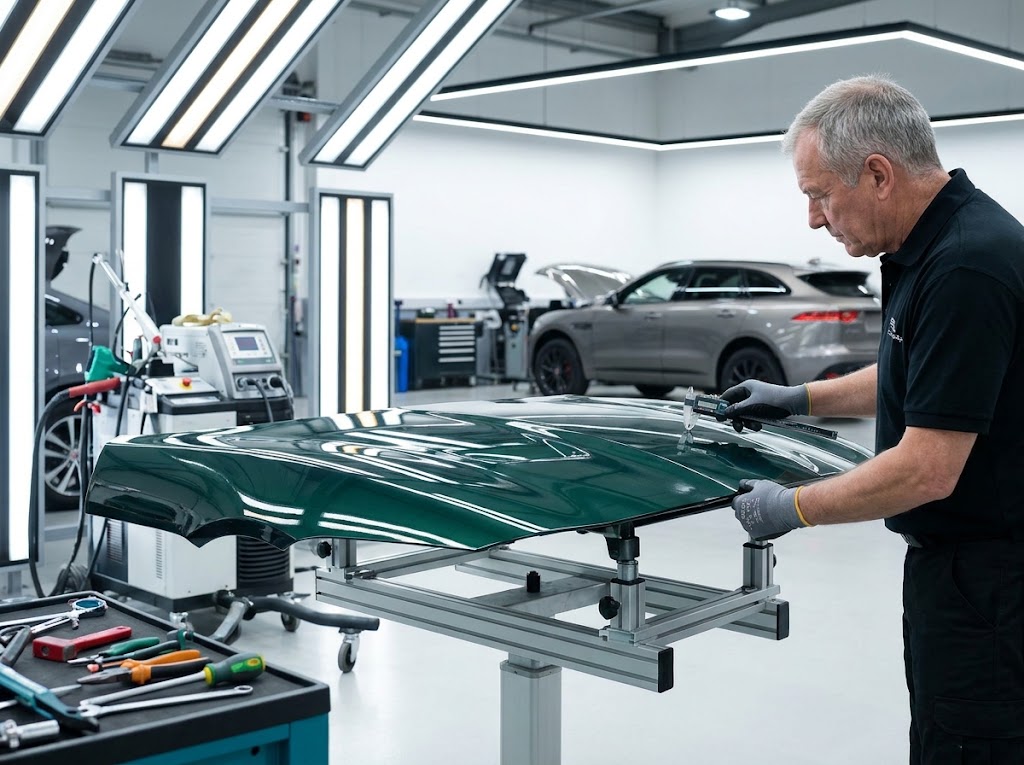
Jaguar has built its cars around aluminium for more than two decades. The 2003 XJ arrived with an all-aluminium monocoque held together by rivets and structural adhesive rather than spot welds, and the same thinking runs through today's F-Type, F-Pace, XF, XE and I-Pace.
That changes almost everything about bodywork. Aluminium is light and resists rust, but it behaves differently under a hammer, under heat and next to other metals. Good Jaguar body repair in Dubai starts with understanding the metal.
- It moves differently. Aluminium has less elastic memory than steel, so dents are worked out slowly and in stages to avoid stretching or thinning the panel.
- Heat gives no warning. Aluminium does not change colour before it is overheated, so any heat used on a panel is measured, never guessed.
- It reacts with steel. Steel dust, steel tools or a bare steel fastener against aluminium can start galvanic corrosion, so the two are kept apart throughout the job.
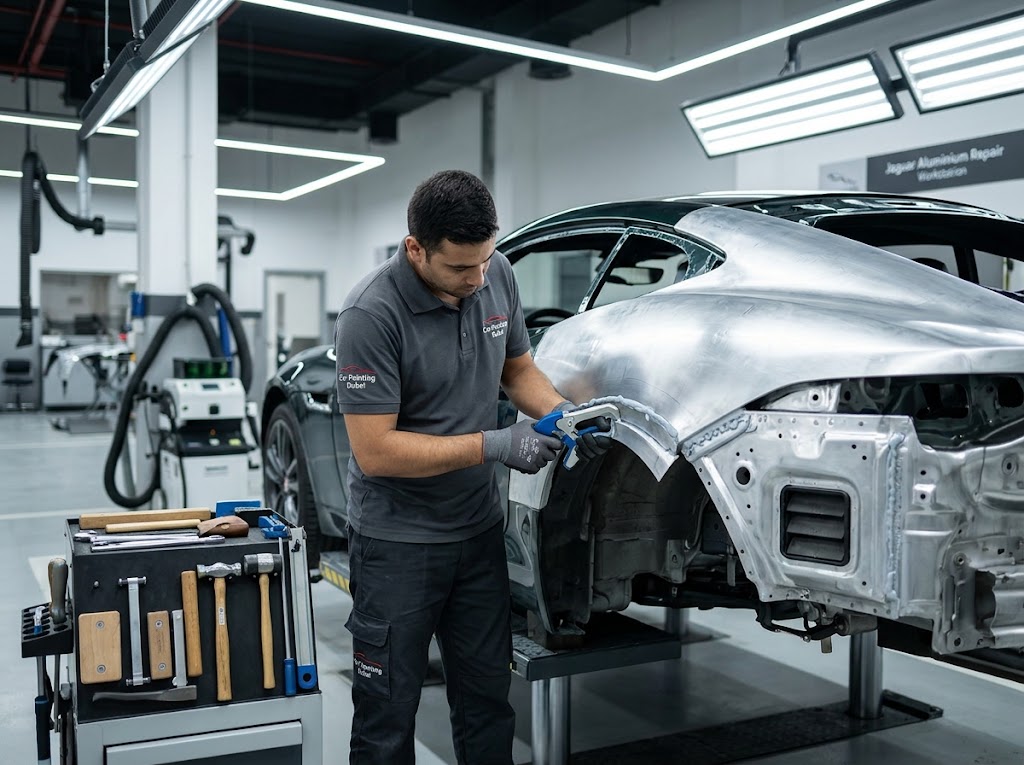
- It is joined, not welded. Many joints rely on self-piercing rivets and structural adhesive, which need the right materials and the right sequence.
None of this is visible when the car leaves a workshop. It shows up later, as bubbling under the paint, a seam that cracks or a panel that never quite sits right. That is why the method matters as much as the finish.
Jaguar Models We Repair
We repair and refinish the full modern Jaguar line-up, along with earlier models that are still well kept in Dubai. Each one has its own mix of materials, panel shapes and paint finishes, and we plan every job around the specific car in front of us.
F-Type
Coupé and convertible with an aluminium body, a long one-piece bonnet and rear haunches pressed into a single body side. Panel work here is about patience, tight gaps and a seamless finish across very large surfaces.
F-Pace
Jaguar's aluminium-intensive performance SUV. Its tall bumpers, wide rear haunches and sensor-heavy corners take most of the scrapes we see, and its metallic finishes need careful blending along the long body sides.
E-Pace
The compact SUV uses a mainly steel structure with an aluminium bonnet, front wings, roof and tailgate. Mixed metals make corrosion isolation even more important wherever those panels meet the steel body.
XF and XE
Both saloons share Jaguar's aluminium-intensive architecture. Typical work covers bumper corners, door dings and boot lid repairs, with paint matched to finishes that look very different in Dubai sunlight and in shade.
XJ
The flagship saloon has an all-aluminium riveted and bonded body. Long doors and a wide, flat bonnet and roof show every ripple, so panel straightness is checked under raking light before any paint goes on.
I-Pace
Jaguar's electric SUV is one of the most aluminium-rich cars on the road. We handle its bodywork and paint with the high-voltage system left untouched, and keep booth curing within limits that suit an electric car.
The table below sums up how each current model is built and where we most often see paint and body problems on it.
| Jaguar model | Body construction | Common paint/body issue |
|---|---|---|
| F-Type | Aluminium body, riveted and bonded, with one-piece body sides | Stone chips on the long bonnet; kerb scrapes on the rear haunches |
| F-Pace | Aluminium-intensive monocoque with steel in selected areas | Rear bumper and sensor scuffs; scratches along the body sides |
| E-Pace | Mainly steel, with aluminium bonnet, front wings, roof and tailgate | Bumper corner scrapes; corrosion where mixed metals meet after poor earlier repairs |
| XF | Aluminium-intensive saloon structure | Front bumper chips; door edge dings; faded gloss-black trim |
| XE | Aluminium-intensive saloon structure | Boot lid and rear bumper damage; wheel-arch scrapes |
| I-Pace | Aluminium-intensive, bonded and riveted, with the battery in the floor | Bumper scuffs around sensors; chipped bonnet leading edge |
Damage on your Jaguar?
Send a few clear photos and we will tell you honestly what the repair involves and how long it should take.
How Is Jaguar Aluminium Repair Done Properly?
Jaguar aluminium repair sounds technical, but the principles are simple. Keep the metal clean, join it the way it was designed to be joined, and never let it touch steel. Here is what that means in practice.
Bonding: adhesive as part of the structure
Jaguar uses structural adhesive along many seams. It spreads loads, seals the joint and stiffens the body. When a bonded panel is repaired or replaced, the old adhesive is removed cleanly, the surfaces are prepared, and fresh adhesive is applied and left to cure fully before the panel is finished.
Riveting: self-piercing rivets instead of spot welds
Self-piercing rivets punch through the top sheet and lock into the lower one without heat, so the aluminium keeps its strength. On repairs, old rivets are drilled out precisely and new fasteners of the correct type are set, usually alongside adhesive, so the joint behaves like the original.
Corrosion isolation: keeping steel away
When aluminium and steel touch in the presence of moisture, the aluminium corrodes. That is why aluminium is worked with its own tools, sanding discs and dust extraction, in an area kept clear of steel work. Where steel brackets or fasteners meet aluminium, coated parts and isolating barriers stop the reaction.
Heat control runs through all of it. Aluminium softens if overheated, so any warmth used to ease a dent is kept low and checked with a thermometer, never judged by eye.
Honest advice: Not every Jaguar repair belongs in an independent workshop. If inspection shows damage to the structural rails or crash structure of a riveted and bonded body, we will tell you plainly, explain why, and recommend that part of the work is carried out to Jaguar's own structural procedures.
Big, Sculpted Panels: The F-Type Bonnet and Rear Haunches
Jaguar designers love long, uninterrupted surfaces. That is beautiful on the road and demanding in the paint booth, because a large panel with deep curves leaves nowhere to hide a colour shift or a wave in the metal. It is what makes F-Type body repair a real test of patience.
The F-Type bonnet
The F-Type's bonnet is a long, one-piece clamshell-style panel that runs from the grille almost to the windscreen. There is no natural break line to blend into, so a repair on one corner usually means refinishing the whole bonnet.
Because the bonnet sits at eye level and reflects the sky, flatness matters as much as colour. We check the panel under raking light, correct any low spots, and plan the blend into the wings so the colour flows across the shut lines without a visible edge.
The rear haunches
The swelling rear haunches are the signature of a Jaguar profile, and on the F-Type they are part of a single pressed body side rather than a bolt-on wing. Kerb damage is therefore repaired in place, reshaping the aluminium slowly so the curve keeps its crisp highlight line.
On the F-Pace the haunches are broad and highly visible from behind. A repair that leaves the line slightly flat or too full is obvious in low evening light, so we compare both sides of the car as we work.
Colours that reward patience
Jaguar finishes such as British Racing Green, Firenze Red and Caldera Red have a depth that changes with the viewing angle. We read the factory paint code, then spray test cards and compare them with the car in daylight and under booth lights. Variants of one code are common, so the card, not the code alone, decides the mix.
Our Jaguar Repair Process
Every job follows the same six stages. The order matters as much as the skill, especially on aluminium.
Photo review and inspection
It starts with your photos on WhatsApp, then an in-person inspection at our Dubai workshop. We check panel gaps, paint depth and hidden damage, and confirm which panels are aluminium, steel or composite before planning anything.
Colour identification
We read the paint code from the car and confirm the variant with spray-out test cards. The cards are checked against an undamaged panel in daylight and under booth lighting, so the mix is right before it reaches your Jaguar.
Aluminium panel work
Damaged areas are reshaped with dedicated aluminium tools, in a clean area kept clear of steel dust. Where joints are affected, rivets and structural adhesive are renewed with the correct materials and in the right sequence.
Preparation and masking
Panels are cleaned, sanded and primed with products suited to aluminium. Parking sensors, radar zones, badges and trim are removed or masked, and shut lines are protected so the finish stays crisp at every edge.
Refinishing and curing
Base coat and clear coat are applied in a controlled spray booth, blending into adjacent panels wherever a seamless colour transition needs it. The finish is then cured under controlled booth conditions for a hard, durable surface.
Machine finishing and handover
Once cured, the new paint is machine finished to match the original texture and gloss. We take paint-depth readings, check the colour in daylight, test sensors after refit, and walk you round the car at collection.
Send your Jaguar photos today
A quick WhatsApp with a few angles of the damage is the fastest way to find out what your car needs.
What Jaguar Damage Is Common in Dubai?
Jaguar paint repair in Dubai is shaped by the roads, the car parks and the climate. These are the four problems we see most often, and how each one is handled.
Bonnet stone chips
Long bonnets take the brunt of motorway grit. Small chips are touched in when the damage is limited; dense chipping on the leading edge usually needs the panel refinished and blended so the repair stays invisible.
Rear haunch kerb scrapes
Wide hips make car-park walls and kerbs easy to clip. We reshape the aluminium where needed, rebuild the curve and refinish so the highlight line runs cleanly from the door to the tail lamp.
Bumper sensor scuffs
Bumper corners collect scuffs right where parking sensors sit. Sensors are removed or masked during refinishing, the paint build over them is kept within sensible limits, and every sensor is checked after the bumper goes back on.
Sun-faded gloss-black trim
Gloss-black window surrounds, mirror caps and grille trim can haze or turn grey after years of strong sun. Painted parts can be refinished to a deep, even gloss black that sits right next to the body colour.
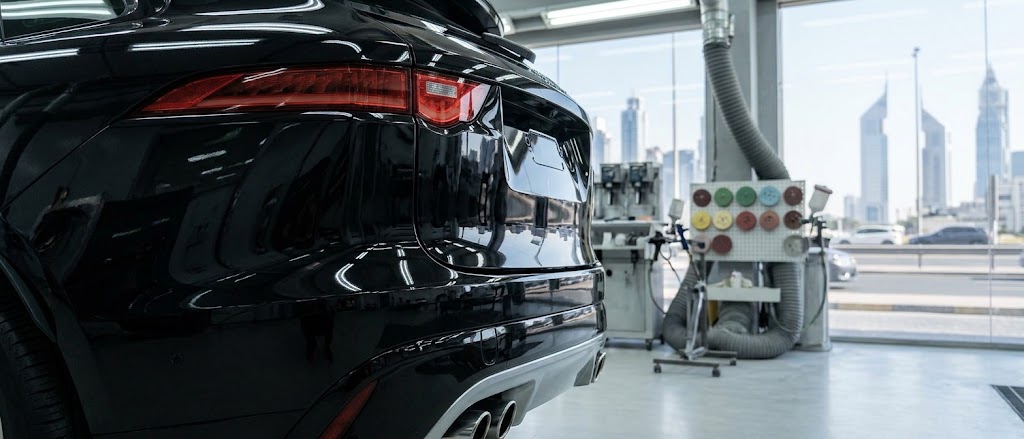
The paint itself suffers in this climate too. Strong UV and heat soften clear coat over time, so a repair needs the same hardness and gloss as the factory finish to age at the same pace. Much of the F-Pace paint repair we carry out starts at the rear bumper, where reversing sensors and low walls meet.
Choosing a Jaguar Body Shop in Dubai: Your Checklist
Whichever workshop you choose, these are the questions worth asking. The answers distinguish the best Jaguar body shop in Dubai from a general garage that happens to paint cars.
- Does it work on aluminium every week? Ask how aluminium is kept apart from steel, which tools are dedicated to it, and how heat is controlled.
- Can it explain rivets and adhesive? A good answer covers self-piercing rivets, structural adhesive and full cure times, not just filler and paint.
- How does it match colour? Look for paint-code reading, spray-out test cards and blending into adjacent panels, not a single mix sprayed straight on.
- Does it respect the sensors? Parking sensors and radar zones need masking or a controlled paint build, plus a check after refit.
- Will it tell you what it should not do? An honest workshop names the limits of its work, especially on structural damage.
- Is it a paint and body specialist? Paint and bodywork should be the core of the business, not a sideline to servicing.
We have worked as a paint and body specialist in Dubai since 2015, and we are happy to answer every one of these questions before you hand over the keys.
Scope Note: What We Do and What We Do Not
Car Painting Dubai is an independent paint and body specialist. We are not part of Jaguar's own network and we do not claim manufacturer approval. What we bring is focused experience in aluminium bodywork and refinishing for Jaguar owners in Dubai.
We focus on paint and bodywork only. Mechanical, electrical and high-voltage work is outside what we do, and if your Jaguar needs any of it, we will say so plainly.
Where a repair touches systems beyond the body, such as driver-assistance cameras or radar that need setting up after a bumper is refitted, we tell you before work starts so there are no surprises at collection.
Frequently Asked Questions About Jaguar Body Repair
Are Jaguar bodies made of aluminium?
Most modern Jaguars are aluminium-intensive. The XJ, F-Type, F-Pace, XF, XE and I-Pace use riveted and bonded aluminium structures, with steel in selected areas on some models. The E-Pace is the main exception, with a mostly steel body and an aluminium bonnet, front wings, roof and tailgate. We confirm the materials on your car before planning any repair.
Can you repair riveted and bonded aluminium panels?
Yes. We repair aluminium panels with dedicated tools kept apart from steel, renew self-piercing rivets and structural adhesive where joints are affected, and control heat throughout. If inspection shows damage to the main crash structure, we will tell you honestly and explain why that part of the work should follow Jaguar's own structural procedures.
Can you repaint a full F-Type bonnet to match?
Yes. The F-Type bonnet is a long, one-piece panel with no natural break line, so a full refinish is often the cleanest result. We match the colour with test cards, blend into the front wings where needed and check flatness under raking light, so the bonnet reads as original from every angle.
Do you match British Racing Green and other Jaguar colours?
Yes. We read the factory paint code, then spray test cards to find the exact variant, because shades under one code can differ. British Racing Green, Firenze Red, Caldera Red and the metallic greys and blues are compared in daylight and under booth lights before the panel itself is painted.
How long does a Jaguar body repair take?
It depends on the damage. A bumper scuff or a few bonnet chips can often be done in one to two working days. A full panel refinish usually takes a few days, and aluminium panel work with rivets and adhesive needs longer because the adhesive must cure fully. We give you a realistic timeframe after inspection.
Will the parking sensors work after a bumper respray?
They should, when the job is done properly. Sensors are removed or masked during refinishing, and the paint build over sensor areas is kept within sensible limits so readings are not affected. After the bumper is refitted, we check every sensor. If a driver-assistance system needs setting up, we tell you before work begins.
Do you repair the I-Pace electric model?
Yes, for bodywork and paint. The I-Pace is one of the most aluminium-rich cars on the road, so the same aluminium discipline applies. We do not touch the high-voltage battery or electrical system, and we keep booth curing within the limits that suit an electric vehicle with its battery in the floor.
Why does gloss-black Jaguar trim fade in Dubai?
Gloss-black trim has a thin finish that takes the full force of Dubai sun and heat. Over time UV breaks down the surface, leaving it hazy or grey, and harsh cleaning products speed that up. Where the trim is painted, we can refinish it to a deep, even gloss black that matches the rest of the car.
Will the repair affect resale value?
A well-matched, properly prepared repair should be hard to detect. Buyers and inspectors look for colour mismatch, uneven texture and unusual paint depth, so we blend carefully, machine finish to the original texture and record paint-depth readings. A clean, honest repair is far better for value than visible damage left on the car.
How do I get my Jaguar assessed?
Send a few clear photos of the damage on WhatsApp, including one close-up and one from further back. We reply with an honest first view of the repair and the time it should take, then arrange an in-person inspection at our Dubai workshop to confirm the details before any work begins.
Choose the Best Jaguar Body Shop in Dubai for Your Car
Send a few clear photos of the damage on WhatsApp, or call the workshop to talk it through. We will give you a straight answer on the repair, the time it needs and how we will match your Jaguar's finish.