
Best Maserati Body Shop in Dubai
If you are looking for the best Maserati body shop in Dubai, start with a workshop that specialises in paint and bodywork rather than servicing. We repair dents, scrapes and tired finishes on Ghibli, Levante, Grecale, GranTurismo and MC20, matching multi-layer Italian colours panel by panel. Send a photo and we will explain what your repair involves.
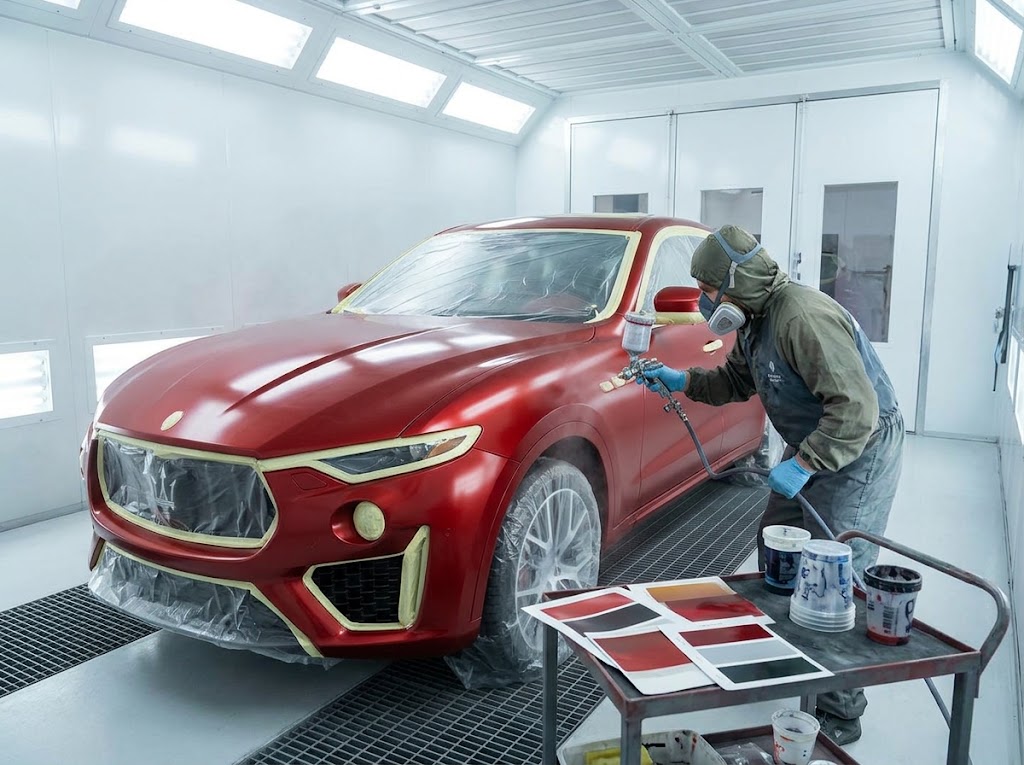
Why Do Maserati Colours Need a Careful Hand?
Maserati colours are designed to be seen in strong light, and Dubai supplies plenty of it. Shades such as Blu Emozione, Rosso Magma and Grigio Maratea are built in several layers, so their depth shifts as you walk around the car. A repair that only matches head-on will give itself away at an angle.
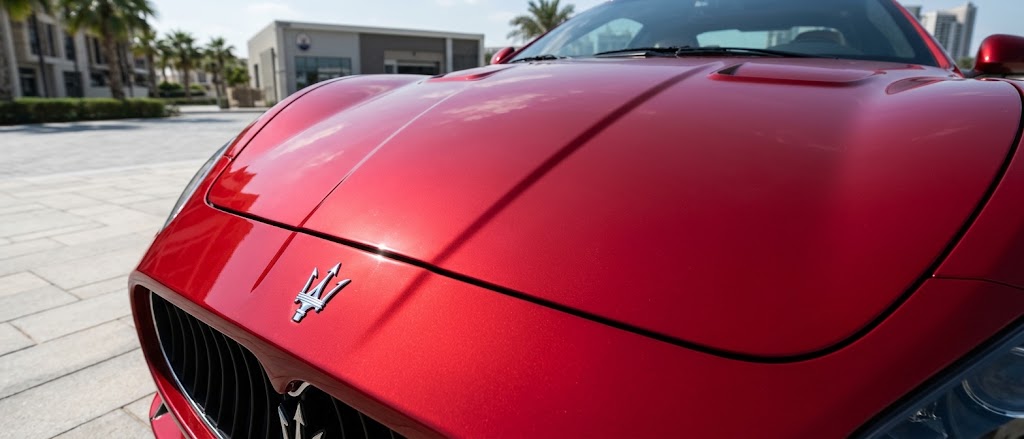
The bodywork makes it harder. Long sculpted bonnets, swelling rear haunches and the concave trident grille bend light across wide surfaces, which exposes any difference in tone, texture or flake direction. That is why we treat every Maserati as colour work first and panel work second.
- Read the code, then the car. The factory code is a starting point. We compare it against the actual panels, which may have spent years in Dubai sun.
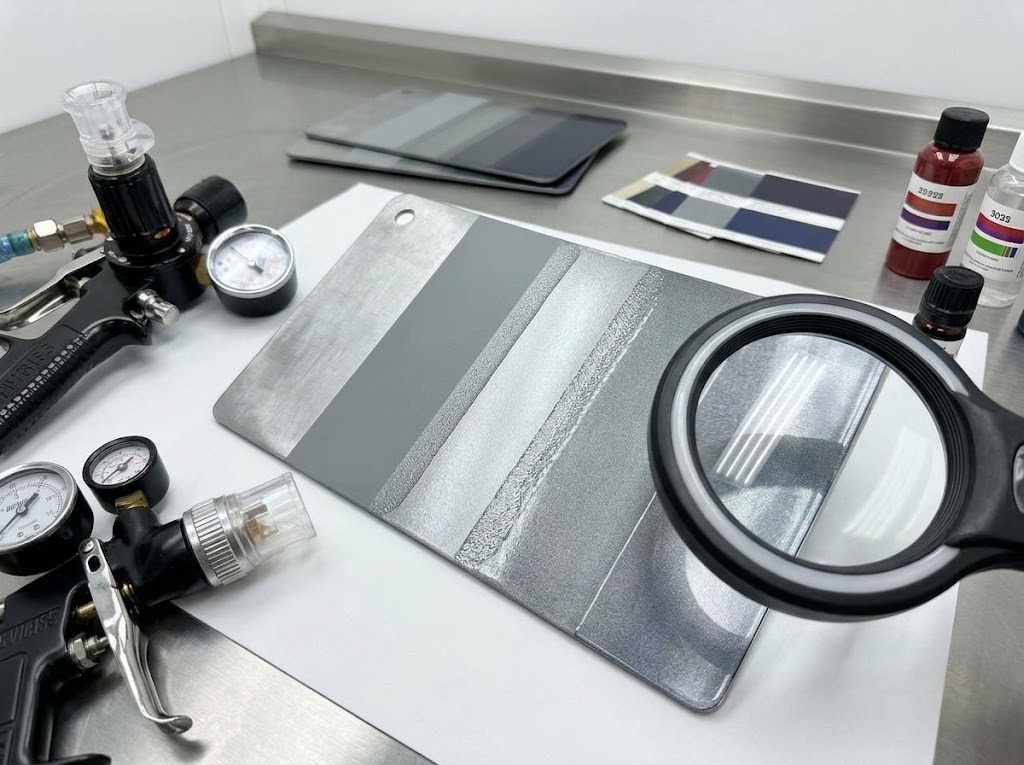
- Spray-out cards before the car. Every colour is tested on cards and checked in daylight and under booth lighting before any panel is painted.
- Blend, don't box. Where the colour demands it, we fade new paint into the neighbouring panels so there is no hard edge for the eye to find.
Maserati Models We Repair
We work on the Maserati range you see on Dubai roads, from the saloons and SUVs of the last decade to the newest generation. Each model has its own panel shapes, materials and trim, and we plan the repair around them.
Ghibli
The Maserati we see most often. Ghibli paint repair usually means bumper corners, door edges and bonnet chips, with careful work around the side vents and the frameless door glass.
Quattroporte
A long saloon with long, flat panel runs where colour drift is easy to spot. We plan blends across doors and rear quarters so the side profile reads as one continuous colour.
Levante
Levante body repair is mostly lower-body work: wheel arch scrapes, sill damage and bumper scuffs from car parks and desert tracks. Its tall flanks need patient blending to keep the colour even.
Grecale
The newer compact SUV, including the Folgore electric version. We handle its slim lighting, sensor-filled bumpers and modern multi-layer colours, following low-temperature curing practice on cars that carry a high-voltage battery.
GranTurismo / GranCabrio
The new generation uses extensive aluminium in its body, which calls for aluminium-only tools and careful heat control. We refinish the long bonnets and wide haunches with the patience a grand tourer deserves.
MC20
A carbon-fibre tub with composite body panels and optional exposed carbon. Composite and carbon need different repair methods to steel or aluminium, and visible weave needs a clear finish that keeps it crisp.
Send Us the Damage, Not a Description
A few clear daylight photos let us judge the panel, the colour and the likely time off the road.
Tri-Coat and Multi-Layer Colours: Why Does the Middle Layer Decide the Match?
A tri-coat colour is built in three stages: a ground coat, a translucent mid-coat carrying pearl or coloured pigment, and a clear coat on top. What you see is light passing through the mid-coat and bouncing back off the ground coat, so the colour lives between the layers rather than in any one of them.
That is why the middle layer decides the match. One extra pass of mid-coat makes the panel deeper; one fewer leaves it pale. With Maserati tri-coat paint, we spray stepped cards with different numbers of mid-coat passes, choose the one that matches your car, then repeat that exact build on the panel.
Metallic and pearl flake also has to lie the same way as the factory finish. Gun distance, air pressure and flash time all change how flakes settle, which is why a colour can look right from the front and wrong from the side. We check every card at several angles before committing.
| Paint type | How it's built | Repair approach |
|---|---|---|
| Solid | A single pigmented colour coat under clear lacquer | Adjust the mix to the car, then refinish the panel. Blending is often minimal, but sun fade on older cars can still call for it. |
| Metallic | A base coat carrying aluminium flake, sealed under clear | Spray-out cards for flake size and direction, then blend into adjacent panels to hide the edge. |
| Pearl / tri-coat | Ground coat, translucent pearl or coloured mid-coat, then clear | Stepped cards to set the number of mid-coat passes, wider blends and strict layer-by-layer consistency. |
| Matte | A colour coat under a low-gloss clear that cannot be polished back | Refinish whole panels to a natural edge. No spot repairs or machine polishing, as both leave shiny patches. |
| Fuoriserie special | Bespoke shades, colour-toned clears, matte or multi-layer builds from the personalisation programme | Identify the exact build first, then make and test the colour from scratch before any panel is touched. |
Common Maserati Damage in Dubai
Dubai driving leaves a recognisable pattern on a Maserati. Long bonnets catch highway grit, wide rear arches meet kerbs and car park pillars, low front lips meet ramps, and the sun works on every horizontal panel.
Long-bonnet stone chips
Sand, gravel and debris from construction traffic pepper the leading edge of the bonnet. Small chips can often be filled and levelled; dense chipping usually needs the bonnet refinished and blended into the wings.
Rear haunch kerb scrapes
The wide rear arches sit outside the line of the doors, so they touch pillars and kerbs first. We repair the dent or gouge, then blend across the curve of the quarter panel.
Front lip scuffs
Low splitters and front bumper lips grind on speed humps and steep ramps. Plastic is repaired or reshaped where it is sound and replaced where it is cracked through, then refinished in colour or textured black.
Sun-dulled clear coat
Years of strong UV dull the clear coat on the bonnet, roof and boot lid. Where enough clear remains, machine finishing brings back the gloss; where it has thinned or failed, the panel is refinished.
Good to know: Not every mark justifies a respray. A single chip that has not reached bare metal can sometimes be touched in and left, and we will tell you when the honest answer is to leave a panel alone. Paint-depth readings guide that advice, not guesswork.
Our Maserati Repair Process in Six Steps
Every Maserati goes through the same sequence. It is not slow for its own sake: each step exists because skipping it shows up later in the finish.
Photo review and inspection
You send photos on WhatsApp and we give an initial view. When the car arrives, we inspect it in good light, take paint-depth readings and note any earlier repairs, so nothing surprises either of us halfway through.
Paint code and spray-outs
We read the factory paint code, mix the colour and spray test cards, including stepped cards for tri-coat finishes. Cards are compared against the car in daylight and booth light until the match holds at every angle.
Strip and protect
Badges, the trident, grille parts, lamps and trim are removed where practical and masked where not. Parking sensors and camera lenses are protected, and the interior and glass are covered before any dust is made.
Panel and body repair
Dents are pulled or worked out with methods suited to steel, aluminium or composite. Filler is kept to the minimum, and the repaired area is shaped to follow the original body lines and feature creases.
Refinish and blend
Primer, colour and clear go on in a controlled booth, layer by layer, using the same number of passes as the approved test card. New colour is blended into adjacent panels and cured under controlled conditions.
Finish and handover
The new paint is machine finished to match the surrounding texture. Parts are refitted, sensors are checked, and the car is inspected outdoors in daylight before you collect it.
Earlier Repair No Longer Matching?
Photograph it beside an original panel and send it over for a straight second opinion on the colour.
Fuoriserie and Special Colours
Fuoriserie is Maserati's personalisation programme, and it opens the palette well beyond the standard catalogue. Owners can specify bespoke shades, multi-layer colours, matte finishes and contrasting details, so some cars in Dubai wear colours that very few others share.
These finishes take more groundwork. A bespoke colour may not exist in any standard formula library, so we build the match ourselves from the factory information and the car itself, testing card after card. Matte and toned-clear builds leave no room for polishing out errors, so the layer build has to be right first time.
The same care applies to the newest generation. MC20 owners often specify exposed carbon, which we keep clear and even rather than painting over, while GranTurismo and GranCabrio Folgore cars carry modern multi-layer colours on aluminium panels. In each case we confirm the exact build before the car is booked in.
How Do You Choose the Best Body Shop for a Maserati in Dubai?
Whichever workshop you choose, ask these questions first. A good Maserati specialist will answer them plainly, and the answers tell you more than any brochure.
- Do they spray test cards? Ask to see spray-outs for your colour before painting. For tri-coat colours, ask how many mid-coat passes they tested.
- Do they measure paint depth? Readings before and after show how much paint is on the car and whether earlier repairs exist.
- Will they blend? A workshop that promises to paint only the damaged panel on a pearl or metallic colour is risking a visible edge.
- How do they handle trim? The trident, badges, side vents and sensors should be removed or properly masked, never painted around in a hurry.
- Can they work with aluminium and composite? Newer GranTurismo and MC20 bodies need suitable methods, not habits learned on steel.
- Will they say no? An honest workshop tells you when a chip is better left alone or when a repair falls outside its scope.
- Do they check in daylight? Booth lighting flatters paint. The final inspection should happen outside.
Scope Note: What We Do and Do Not Do
Car Painting Dubai is an independent paint and body specialist. We are not a Maserati main agent and do not claim factory approval. What we offer is focused refinishing and bodywork, carried out with the care these cars need.
We focus on paint and bodywork only, so mechanical, electrical and high-voltage work sit outside what we do. If your car needs sensor calibration or mechanical attention after an impact, we will say so clearly so you can arrange it with the right specialist.
We work directly with Maserati owners in Dubai, one car at a time, and we keep you updated with photos as the work moves from bodywork to paint to finishing.
Frequently Asked Questions About Maserati Body Repair
Can you match Maserati tri-coat colours?
Yes. We read the factory paint code, then spray stepped test cards with different numbers of mid-coat passes and compare them with your car in daylight and booth light. The card that matches decides the exact layer build on the panel, and we blend into adjacent panels so the colour flows without a visible edge.
Do you repair the newer Grecale and GranTurismo?
Yes, including the Folgore versions. The GranTurismo's aluminium-intensive body needs suitable tools and controlled heat, and the Grecale's sensor-filled bumpers need careful masking or removal. We plan each repair around the car's materials and colour build rather than treating it like an older model, and we test the colour on cards before any panel is painted.
Can you repair MC20 carbon and composite parts?
We repair and refinish composite body panels, and we can refinish exposed carbon with a fresh clear finish where the weave itself is undamaged. Structural carbon, including the tub, is a different matter. Cracks or impact damage there need assessment by the right specialist, and we will tell you plainly if that applies to your car.
How long does a Maserati bumper respray take?
A straightforward bumper respray usually takes around two to three working days, allowing for colour matching, preparation, booth curing and finishing. Tri-coat colours, deeper damage or a bumper that needs blending into the wings can add time. We confirm the expected time once we have seen your photos or the car itself.
Will parking sensors work after the repair?
They should. Sensors are removed or masked before painting, and where sensor caps are painted we keep the paint layer thin so the signal is not affected. Every sensor is checked before handover. If a sensor or camera was damaged in the original impact, we will tell you, as replacement and calibration sit outside our paint and bodywork scope.
How do you protect the trident grille and badges?
Where practical, the trident, grille parts, Saetta badges and side vents are removed before painting and refitted afterwards with suitable clips. Where removal risks breaking a part, we mask it closely and protect the chrome from overspray and polishing compound. Either way, the surrounding paint ends cleanly at the trim rather than ragged around it.
Can stone chips on a long bonnet be fixed without a full respray?
Often, yes. Isolated chips that have not spread can be filled, levelled and finished so they are hard to spot. Dense chipping across the leading edge is different, and refinishing the bonnet with a blend into the wings gives a better result. We check chip density and paint depth, then tell you honestly which approach suits your car.
Do you work on Folgore electric models?
Yes, for paint and bodywork. We follow low-temperature curing practice for cars with high-voltage batteries and never work on the high-voltage system itself. If an impact may have affected the battery or underbody, the car should be checked by a qualified EV technician first, and we will advise you to do that before any bodywork begins.
Will the repair be noticeable at resale?
A properly matched and blended repair should not be visible to the eye. A buyer with a paint-depth gauge may still detect that panels were refinished, as on any repaired car, so keep a record of the work. What protects value is a finish with no colour shift, no texture difference and no overspray on trim or rubber seals.
How do I get my Maserati assessed?
Send clear daylight photos on WhatsApp to +971 52 791 4606, including one close shot of the damage and one wider shot of the whole panel. Add your model, year and colour name if you know it. We will reply with an initial view and arrange a time to inspect the car in person in Dubai.
Best Maserati Body Shop in Dubai: Send Your Photos
Photograph the damage in daylight, add one wider shot showing the whole panel, and send it with your model and colour name if you know it. We will explain the repair, the time involved and what to expect from the finish.