
Best Car Bumper Paint Repair Shop in Dubai
If your bumper has taken a knock, you need the best car bumper paint repair shop in Dubai: one that treats bumpers as flexible plastic, not metal. We repair parking scuffs, deep scrapes, cracks and split mounting tabs, refinishing with flexible primers and sensor-safe methods so the result survives Dubai's heat.
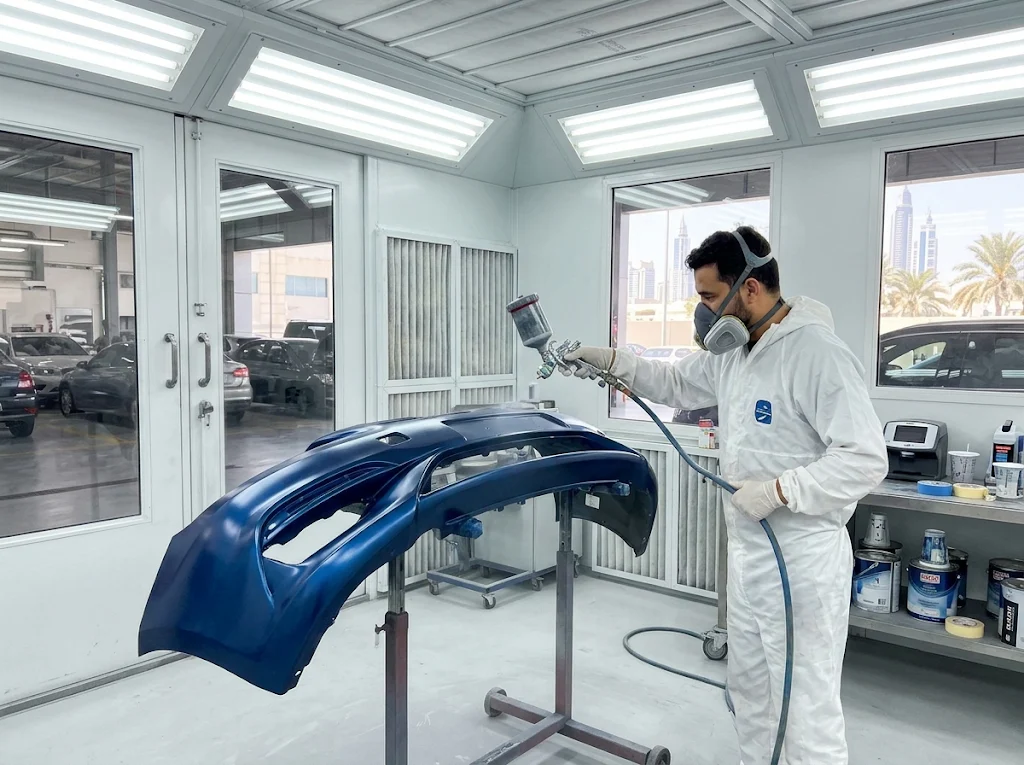
Why Do Bumpers Get Damaged More Than Any Other Panel in Dubai?
The bumper is the first part of the car to meet a pillar, a kerb stop or another car's bumper. In Dubai it also lives through some of the harshest conditions a painted plastic panel can face.
Most modern bumpers are moulded from polypropylene blends rather than steel. They are designed to flex on impact and spring back, which protects the structure behind them but puts unusual stress on the paint sitting on top.
- Tight parking. Narrow mall bays, concrete pillars, spiral ramps and kerb stops make corner scuffs and lower-lip scrapes the damage we see most often.
- Extreme heat. With air temperatures above 45°C, a dark bumper in direct sun gets far hotter. Plastic expands and softens more than metal, so rigid or poorly bonded paint starts to let go.
- Constant UV. Strong sun breaks down the clear coat on upper surfaces first. A repair that was not cleared and cured properly shows its age within a single summer.
- Sand and dust. Fine sand works like an abrasive. Wiping a dusty bumper with a dry cloth, or resting bags on it, leaves fine scratches across the top.
- Humidity. Coastal humidity and morning condensation are why bumper paint needs controlled booth curing rather than open-air drying to bond and harden properly.
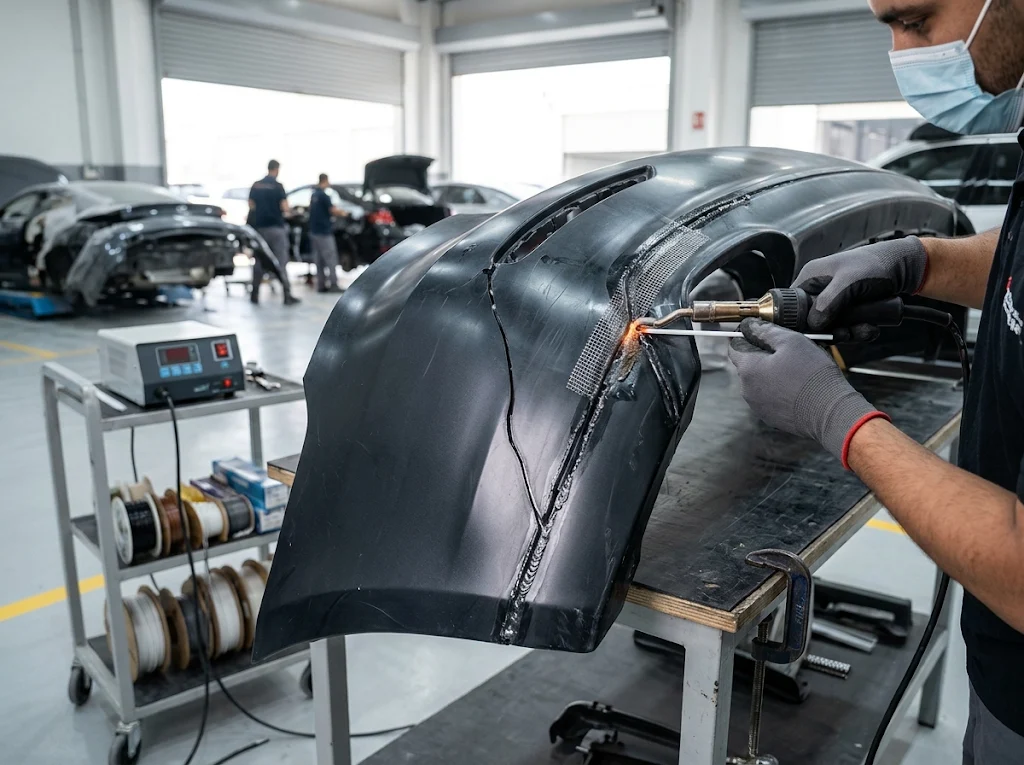
Types of Bumper Damage: From Light Scuffs to Split Tabs
Bumper damage is rarely exactly what it looks like. A small scuff can hide a cracked mounting point, while an ugly scrape may only need refinishing. Each type below calls for a different repair, so identifying it correctly is where good work starts.
Scuffs
Light parking scuffs and paint transfer from pillars or other cars, usually on the corners. Many sit in the clear or base coat only, so bumper scratch repair here means flatting, refinishing and blending, with no filler.
Deep scrapes
Kerb and ramp scrapes that gouge into the plastic itself, often along the lower edge. Torn and raised plastic is trimmed and sanded smooth, then shaped with flexible filler before priming and painting.
Cracks
Splits that run right through the plastic, often starting at a corner or a sensor hole. A lasting cracked bumper repair is welded from behind, because filler and paint alone will simply open up again in the heat.
Split mounting tabs
The hidden tabs and clip points that hold the bumper to the car. When they snap, the bumper sags, gaps open up and the paint edge rubs. We rebuild the tabs so the bumper sits tight again.
Dents and deformation
Plastic bumpers push in rather than dent like metal. With controlled heat and steady pressure from behind, most deformation can be eased back to its original line before any paint work begins.
Paint peeling
Paint lifting in flakes, usually from an earlier repair done without adhesion promoter or flex additive. We strip back to sound material and rebuild the paint layers properly, so the bumper does not peel again.
Not sure what kind of damage it is?
Send a few clear photos on WhatsApp and we will tell you whether it is a surface scuff, a crack or something hidden behind it.
Should You Repair or Replace a Damaged Bumper?
Most bumper damage is repairable, and a properly welded and refinished bumper is as strong and as straight as the original. Repair is not always the right answer, though, and we would rather tell you that before work starts than after.
Repair makes sense when the plastic is all there, cracks are short and away from mounting points, and the bumper still holds its shape. Replacement is usually the better route when large sections are torn or missing, a crack runs through several sensor holes, or the mounting areas are crushed.
We also check behind the cover. The foam energy absorber and reinforcement bar take the real load in an impact, and damage there should never be hidden under fresh paint. Most bumpers are thermoplastics that weld well, but fibreglass parts on some performance cars cannot be welded and are bonded with structural adhesive instead.
Nor does every job need the full bumper respray Dubai owners often expect. A contained corner repair, blended into the surrounding paint, is frequently enough. The table shows how each type of damage is usually handled.
| Bumper damage | Repairable? | Typical approach | Usual time |
|---|---|---|---|
| Light scuff | Yes | Flat back, adhesion promoter on any bare plastic, base coat and clear, blend into the surrounding paint | Same day, around 4–8 hours |
| Deep scrape | Yes | Trim and sand torn plastic, flexible filler, flex primer, refinish the affected area | 1–2 days |
| Crack under 10 cm | Yes, in most cases | Stop-drill the ends, V-groove, weld from behind with matching rod, reinforce, refinish | 1–2 days |
| Split mounting tab | Usually | Rebuild the tab with welded rod and reinforcing mesh, refit and check panel gaps | 1–2 days |
| Large tear | Sometimes | Assess the structure; multi-stage welding if sound, a new bumper painted to match if not | 2–4 days |
| Dent or deformation | Usually | Warm and reshape from behind; refinish only if the paint has cracked or stretched | Half a day to 2 days |
Good to know: These times include proper curing and assume any parts are on hand. Quick touch-ups that skip curing are often the first repairs to peel in a Dubai summer. If replacement is the better fix for your bumper, we will say so before any work begins.
Our Bumper Paint Repair Process in Six Steps
Bumper repairs fail when plastic is treated like a metal panel. This is how every car bumper repair Dubai owners bring to us is handled, with each step chosen for a part that flexes, carries sensors and sits in direct sun.
Inspect and identify
We look at the damage with you, check the mounting points, sensors and absorber, and read the plastic type code moulded on the back. The factory paint code is taken from the car, so colour matching starts with the right formula.
Remove and clean
The bumper comes off the car, and the sensors, grilles, trims and washer jets are taken out. It is then cleaned with a plastic-safe cleaner to remove silicone, road grime and release agents that would stop the paint bonding.
Weld and reshape from behind
Cracks are stop-drilled at each end, V-grooved and welded from the back with rod matched to the plastic, adding reinforcing mesh where needed. Deformed areas are warmed and reshaped, and broken tabs are rebuilt in the same way.
Flexible filler and flex primer
Surface marks are refined with flexible plastic filler, never rigid filler meant for steel. Bare plastic receives an adhesion promoter, then a flexible primer is applied and cured, so the base layers can move with the bumper.
Colour match and refinish
Test cards are sprayed from the paint code and checked against the car in daylight before the bumper is painted. Base coat and clear go on with flex additive, blended into neighbouring panels where needed, then cured in the booth.
Refit, finish and test
The bumper is refitted with new clips where old ones have failed, and panel gaps are checked against the wings and lamps. Sensors return to their holders, parking sensors and cameras are tested, and the finish is machine polished where needed.
Parking Sensors, Cameras and Radar: Painting Around Them Correctly
A modern bumper is more than a cover. It can carry ultrasonic parking sensors, a camera, headlamp washers and, on many cars, radar for blind-spot monitoring or adaptive cruise control. Each one changes how the bumper has to be prepared, painted and refitted.
Some manufacturers also call for a driver-assistance check after any work on a bumper that carries radar. If your car is one of them, we tell you before the job begins, so there are no surprises when you collect it.
Parking sensors
Sensors come out before painting and are refinished on their own with thin, controlled coats, because heavy paint on a sensor face can trigger false warnings. Holders are checked so each sensor points at its factory angle.
Cameras and washers
Cameras, headlamp washer jets and their wiring are unplugged and removed, never just masked and sprayed around. That keeps overspray off lenses and nozzles, and lets the colour reach fully into every opening for a factory-looking edge.
Radar zones
Radar can sit behind the rear corners or the front centre of a bumper. Many manufacturers limit paint thickness over that zone and rule out filler there, so we keep the paint within those limits and check its depth with a gauge.
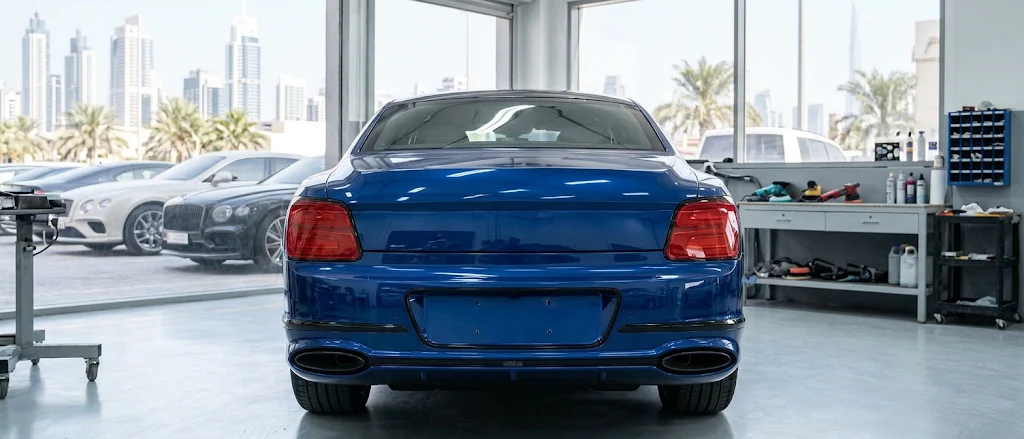
Cracked, sagging or just scuffed?
WhatsApp a close-up and a photo of the whole bumper, and we will tell you how it should be repaired and how long it will take.
Front vs Rear Bumper Repairs: Different Damage, Different Fixes
Front and rear bumpers fail in different ways. Knowing the usual pattern helps us find damage that is not obvious at first glance.
Front bumpers
The front collects stone chips at speed, scrapes along the lower lip from kerb stops, speed humps and steep car park ramps, and corner hits on pillars when turning into tight bays. Grilles, fog lamp surrounds and tow-eye covers often crack at the same time, and the underside of a scraped lip is easy to overlook.
Rear bumpers
The rear usually meets bollards, pillars and other cars while reversing, so the corners take most of the hits. The top surface picks up scratches from luggage and shopping, and a corner knock can disturb blind-spot radar mounted just behind it.
The typical rear bumper repair Dubai drivers ask us for starts as a scuffed corner and turns out to include a split tab, which is why we check the fixings on every reversing impact, not just the paint.
How Do You Choose the Right Bumper Repair Shop in Dubai?
Most bumper repairs look fine on the day they are collected. What sets apart bumper paint repair Dubai drivers can trust is mostly hidden, and it shows up a summer later. Whoever you choose, the best car bumper paint repair shop in Dubai should tick every point below.
- Welds cracks from behind. Filler and paint over a crack is cosmetic. Ask whether the plastic will be welded and reinforced on the back.
- Uses flexible products. Adhesion promoter on bare plastic and flex additive in the primer and clear are what stop cracking and peeling later.
- Removes the bumper. Painting a bumper on the car means masking around sensors and edges, which leaves hard lines and overspray.
- Matches by code and test card. The factory paint code is the starting point; spray-out cards checked against the car confirm the shade.
- Handles sensors properly. Sensors and radar zones need controlled paint thickness and correct refitting, then a working test before handover.
- Tells you when to replace. A workshop that will say a bumper is beyond sensible repair is one you can trust on everything else.
Keeping Your Bumpers Looking Good: Parking Tips for Dubai
A freshly painted bumper needs a little care in its first few weeks, and a handful of parking habits prevent most of the damage we repair.
- Stop short of kerb stops. Many bays have concrete stops taller than a low front lip. Stop before you reach them rather than rolling forward until something touches.
- Swing wide past pillars. Most corner scuffs happen while turning into or out of a bay beside a concrete pillar. Take the turn slowly and give the corner more room.
- Use sensors and eyes together. Parking sensors can miss thin poles and low kerbs. Check the camera and mirrors too, especially on spiral ramps.
- Rinse before you wipe. Rinse sand away before washing. A dry cloth drags grit across the clear coat and leaves the fine scratches that dull a bumper.
- Give new paint time. For the first few weeks after a repair, keep pressure washer nozzles well away from bumper edges and sensors, and avoid machine polishing.
Frequently Asked Questions About Bumper Paint Repair
Can a cracked bumper be repaired instead of replaced?
Usually, yes. Most bumpers are thermoplastic, so cracks can be welded from behind with matching rod and reinforced, which makes the repair structural rather than cosmetic. Replacement is the better choice when sections are missing, a crack runs through several sensor holes or the mounting areas are crushed. We will tell you which applies once we have seen photos.
How long does bumper paint repair take?
A light scuff is often finished the same day, in around four to eight hours. Deep scrapes, short cracks and split tabs usually take one to two days, because welds, primer and paint all need proper curing time. Large tears or replacement bumpers can take two to four days, depending on parts. We confirm timing after seeing photos.
Will my parking sensors work after the bumper is painted?
They should, provided they are handled correctly. We remove the sensors before painting, refinish them on their own with thin, controlled coats and refit them in their holders at the factory angle. Thick paint on a sensor face is a common cause of false warnings after poor repairs. Every sensor is tested before the car is handed back.
Will the paint crack again because bumpers flex?
Not if the right products are used. Bare plastic gets an adhesion promoter, the primer and clear coat carry flex additive, and cracks are welded rather than filled, so the paint layers can move with the bumper. Paint usually cracks on bumpers when rigid metal-panel products were used, which is something we avoid at every stage.
Can you repair just the corner of a bumper?
Often, yes. Corner scuffs from pillars and tight bays are the most common bumper damage in Dubai. Where the damage is contained, we repair the corner and blend the new colour into the surrounding paint so there is no visible edge. If the damage reaches across the face of the bumper, refinishing the whole panel gives a better result.
Do you repair broken bumper mounting tabs?
Yes. Split or snapped tabs are rebuilt by plastic welding with matching rod and reinforcing mesh, then shaped so the clips seat properly again. This stops the bumper sagging, closes uneven panel gaps and prevents the paint edge rubbing against the wing or lamp. If the break is in a bolt-on bracket rather than the bumper itself, replacing the bracket is usually the better fix.
Will the bumper match the colour of the rest of the car?
It should. Bumpers are a common place for mismatches, because plastic panels can take colour slightly differently from metal ones. We start with the factory paint code, spray test cards and compare them against the car in daylight, adjusting the mix until it matches. Where needed, the colour is blended into the neighbouring paint so the eye sees one even finish.
Do you repair front and rear bumpers?
Yes, both. Front bumpers tend to need work on the lower lip, corners and stone-chipped face, often with grilles, washer jets and sensors to remove. Rear bumpers usually come in with corner hits from reversing, scratched top surfaces and split tabs, sometimes with blind-spot radar in the corners. Each is assessed and refinished with its own fittings in mind.
Can I drive the car straight after a bumper repair?
Yes. The bumper is cured in the booth before it is refitted, so the car is ready to drive when you collect it. The paint keeps hardening for a few weeks, though, so avoid pressure washing close to the repaired area and skip machine polishing during that time. Normal hand washing is fine.
How do I send photos of my bumper damage?
Tap the WhatsApp button on this page and send two or three clear photos: one close to the damage, one of the whole bumper and one from a low angle along the edge. Daylight works best. Add your car's make, model and year, mention any sensor warnings, and we will reply with what the repair involves and how long it takes.
Best Car Bumper Paint Repair Shop in Dubai: Start With a Photo
Take one photo close to the damage and one of the whole bumper, then send both on WhatsApp. We will tell you whether it needs welding, refinishing or replacement, and how long the car will be with us. Prefer to talk it through? Call the workshop.