
Best McLaren Body Shop in Dubai
If you are looking for the best McLaren body shop in Dubai, you need a workshop that understands carbon and composite panels, not just paint. We repair the 750S, 720S, Artura, GT and the rarer Longtail and Ultimate Series cars, match factory and MSO colours, and handle dihedral doors with care. Send photos for a clear repair plan.
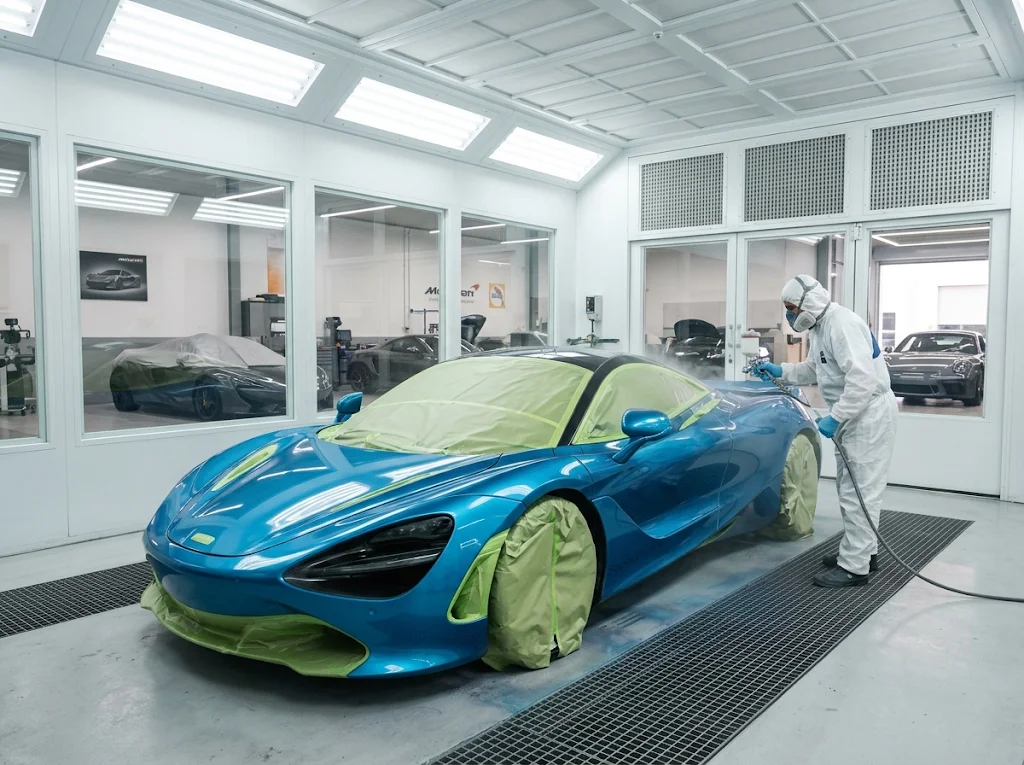
Why Do McLaren Owners Need a Specialist Paint and Body Shop in Dubai?
Dubai is a McLaren city. You see 720S and 750S coupés on Sheikh Zayed Road every evening, Arturas in villa driveways and the occasional Senna waiting at a hotel entrance. More of these cars on the road means more scraped noses, chipped doors and scuffed diffusers.
A McLaren is not built like a saloon. It sits on a carbon fibre tub, and much of the bodywork you see is composite, carbon or aluminium rather than pressed steel. The fillers, primers and curing temperatures that suit a steel wing can harm a composite panel.
A general garage may get the colour close. A specialist identifies the material first, then plans the repair around it, so the finish stays stable through Dubai summers instead of shrinking, cracking or showing the repair line a few months later.
- Material first. Every damaged panel is confirmed as composite, carbon or aluminium before anything touches it.
- Colour depth. McLaren paints are often multi-layer metallics, pearls and tinted clears that need test cards, not guesswork.
- Discretion. Owners of these cars expect privacy, careful handling and no photos of their car shared without permission.

McLaren Models We Repair in Dubai
Each McLaren generation uses slightly different materials, panel shapes and paint options, so every repair is planned around the exact car in front of us. These are the models we see most often, from the current range to the rarer limited runs.
McLaren 750S
The newest Super Series car, with a sharper front end and a low splitter that meets ramps early. We repair bumper scrapes, carbon trim chips and door-edge damage on both the coupé and the Spider.
McLaren 720S
Still one of the most common McLarens on Dubai roads. Its wide nose and sculpted headlight surrounds collect stone chips, and the deep front bumper is the panel we refinish most often on this model.
McLaren Artura
A plug-in hybrid built on a newer carbon architecture, with its own panel set and colour palette. We take extra care masking sensors, cameras and the charging-port surround during preparation and refinishing.
McLaren GT and GTS
The grand tourer of the range and often a daily car. A longer front overhang means more kerb and ramp contact, and the large glass tailgate needs careful masking whenever the rear is refinished.
McLaren 765LT
Longtail cars carry more exposed carbon fibre, from the front splitter to the extended rear wing. Repairs here often mean restoring clear lacquer over the carbon weave rather than painting body colour.
McLaren Senna and Elva
Ultimate Series cars are rare and heavily specified, often with MSO paint and visible carbon. We treat them with a full photographic record and a repair plan agreed panel by panel before work begins.
Scraped your McLaren's nose this week?
Send two or three photos on WhatsApp and we will tell you what the repair involves and how long it takes.
How Are McLaren Carbon and Composite Body Panels Repaired?
Every modern McLaren is built around a carbon fibre monocoque, the tub that carries the suspension, seats and crash structure. Bolted to it are body panels made from composites, carbon fibre or aluminium, depending on the model and specification.
Composite panels do not dent the way steel does. They scratch, crack, craze or, after a harder knock, delaminate, where the layers split apart. That changes how they are repaired.
We start by finding the depth of the damage. A scuff that stays within the clear coat and colour is a refinishing job. A crack into the fibre needs structural filling and reinforcement from behind before any paint goes on.
We use flexible primers and adhesion promoters made for plastics and composites, and cure them at controlled temperatures so trapped air and resin do not push pinholes up through the new paint. This is where McLaren body repair in Dubai differs most from work on a steel-bodied car.
Exposed carbon needs a different approach again. If the weave is intact and only the lacquer is chipped or hazy, we flat and re-lacquer it so the pattern shows through cleanly. If the fibres themselves are broken, we will tell you that replacement is the honest answer.
| McLaren part | Material | Repair approach |
|---|---|---|
| Front bumper | Moulded plastic composite | Scrapes and cracks repaired on the original part, flexible primer applied, then refinished and blended towards the bonnet edge. |
| Bonnet | Composite or aluminium, depending on model | Material confirmed first, then surface repair, full refinish and blending into the front wings where needed. |
| Dihedral doors | Lightweight composite or aluminium outer skin, varies by model | Edge chips filled and refinished with the door supported open; seals, glass and hinge areas masked. |
| Side intakes | Composite, with a carbon finish on some specifications | Painted intakes refinished in body colour; carbon intakes re-lacquered if the weave is undamaged. |
| Rear diffuser | Carbon fibre or textured composite | Lacquer scuffs on carbon flatted and re-cleared to the original sheen; deep gouges in textured sections assessed for replacement. |
| Exposed carbon trim | Carbon fibre with gloss or satin lacquer | Lacquer chips repaired and re-cleared in the matching sheen; broken fibres flagged for replacement. |
Good to know: Damage to the carbon tub itself is a structural matter, not a paint and body job. If an impact has reached the monocoque, we will say so plainly and advise you to have it assessed within McLaren's own network before any cosmetic work is done.
Common McLaren Damage in Dubai
Most of the McLarens we see have not been in a crash. They have simply been driven in Dubai, which means steep basement ramps, tight mall car parks, speed humps and fast motorways with sand and grit on the surface. The damage follows predictable patterns.
Scratches along the flanks, from bollards, trolleys or a careless passer-by, are the other common visit. Most McLaren scratch repair in Dubai is shallow enough to correct on the original panel, which keeps factory paint on the car and paint-depth readings close to standard.
Front splitter and bumper scrapes
The nose lift helps, when it is fitted and used. Basement ramps, villa driveways and petrol station entrances catch the splitter and lower bumper. This is the McLaren bumper repair we carry out most often.
Dihedral door-edge chips
Upward-opening doors meet concrete pillars, low ceilings and neighbouring cars in narrow bays. The leading and lower edges chip first, and small chips let dust and humidity creep under the paint.
Stone chips on the nose and mirrors
Motorway speeds and wind-blown grit pepper the front bumper, bonnet leading edge and mirror caps. Left alone, chips spread. Early refinishing keeps the repair small and more factory paint on the car.
Rear diffuser scuffs
Steep exit ramps and speed humps drag the rear diffuser, especially when a low car leaves a car park at an angle. Scuffs on carbon or painted sections are repaired to match the original sheen.
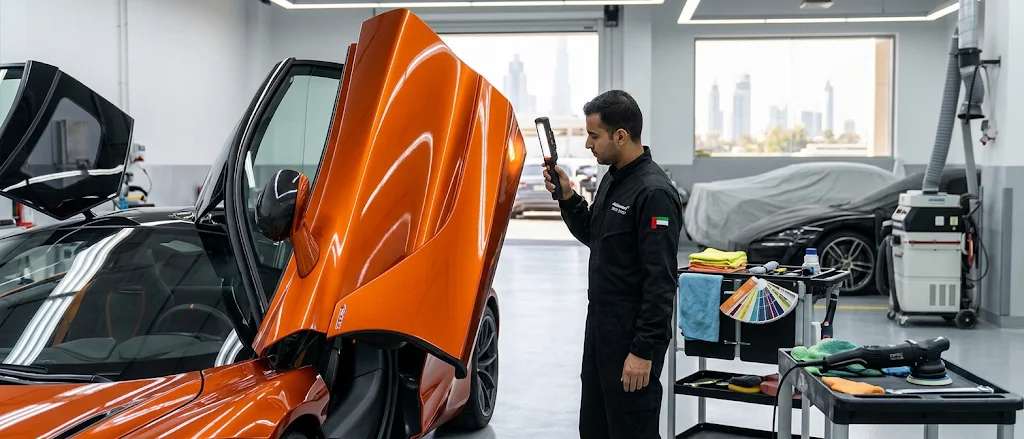
Our McLaren Repair Process, Step by Step
Every repair follows the same six stages, whether it is a single chipped door edge or a full front end. You know what is happening at each point, and nothing is painted until the plan is agreed with you.
Send photos on WhatsApp
Share a few clear photos of the damage, a wider shot of the car and, if you have it, the model and year. We look at the material, the colour and the extent of the damage, then reply with what the repair is likely to involve.
In-person assessment
When the car arrives, we photograph it all round, take paint-depth readings on the damaged and neighbouring panels, and confirm whether each panel is composite, carbon or aluminium. Anything outside paint and bodywork is pointed out, never quietly added.
Preparation and masking
Sensors, cameras, badges, seals and exposed carbon are masked or removed with care. Damaged areas are cleaned of wax and contamination, and composite surfaces are keyed and treated with adhesion promoter so the new layers bond properly.
Composite and panel repair
Scrapes and cracks are rebuilt to the correct contour, with reinforcement where fibre is damaged. Flexible primer is applied, cured and block-sanded until the panel is true under raking light, with no sink marks or visible edges.
Colour match and refinishing
We read the factory paint code, mix the colour and spray test cards to compare against the car in daylight and booth light. Base and clear are then applied, blended into adjacent panels where needed, and cured under controlled conditions.
Finishing and handover
Once cured, the new paint is machine finished to match the surrounding texture and gloss. We check paint depth again, test the sensors, and hand the car back with before-and-after photos and a clear explanation of the work.
Not sure if it is cosmetic or deeper?
Photos are usually enough for a first view, and we will tell you plainly if anything needs more than paint and bodywork.
MSO and Special McLaren Colours
McLaren paints are rarely simple. The standard palette already includes deep metallics, pearls and tinted clears, and McLaren Special Operations, known as MSO, goes much further: heritage shades, bespoke colours matched to an owner's sample, satin finishes and two-tone liveries.
Matching these starts with the paint code, but it does not end there. A factory formula is only a starting point. Each car's colour shifts slightly with production batch and years of Dubai sun, so we spray test cards, compare them in daylight and under booth light, and adjust the tint until the card disappears against the panel.
Bespoke MSO colours may not appear in standard formula databases at all. In that case we work from the car itself, using colour readings and test panels, and build the formula layer by layer. Tinted clear coats need a matching number of coats, or the depth of colour will look wrong next to the original.
Satin and matte finishes cannot be blended or polished in the usual way, because any machine finishing changes the sheen. They are normally refinished edge to edge across the whole panel. We explain this before work starts, so the plan holds no surprises.
This is where McLaren painting in Dubai shows the difference between careful and hurried work: patience with test cards and coat counts matters more than speed.
What Should You Check Before Choosing a McLaren Body Shop in Dubai?
A search for McLaren body shop Dubai returns franchised service centres and multi-brand garages, many of them focused on servicing rather than paint. Before you hand over the keys, ask the questions that tell a specialist from a generalist.
- Do they identify the panel material first? A workshop that treats composite like steel will use the wrong fillers, primers and curing.
- Will they take paint-depth readings? Readings before and after show how much original paint remains, which matters to future buyers.
- How do they match colour? Look for spray-out test cards and blending into adjacent panels, not a mix from the code alone.
- Do they mask sensors and cameras properly? Excess paint build on parking sensors can change how they read.
- Are they honest about limits? Structural carbon damage, broken carbon weave and mechanical faults should be referred on, not painted over.
- How is the car handled? Ask who moves it, where it is kept and whether photos are ever shared without your permission.
- Can they back up their claims? Be cautious of any garage claiming McLaren approval it cannot show in writing.
Paint and Bodywork Only: Our Scope
We focus on one thing: McLaren paint repair and bodywork in Dubai, done to a high standard. That covers composite and panel repair, scratch and chip repair, bumper and splitter refinishing, carbon re-lacquering and colour matching, including MSO shades.
We do not carry out mechanical or electrical repairs, servicing, ceramic coatings, paint protection film, vinyl wraps or window tint. We also work directly with owners and do not handle insurance claims.
Keeping to paint and bodywork means every hour in the workshop goes into the finish on your car. If something falls outside that, we will tell you at the assessment rather than take it on.
Frequently Asked Questions About McLaren Body Repair
Can McLaren composite body panels be repaired?
Yes, in most cases. Scrapes, cracks and chips in composite bumpers, intakes and body panels can be repaired on the original part using primers and fillers designed for composites, then refinished. If an impact has split the panel's layers over a wide area or damaged its mounting points, we will tell you plainly that replacement is the better route.
Can you match McLaren MSO colours?
Yes. We start from the paint code where one exists, then spray test cards and compare them against the car in daylight and booth light, adjusting the mix until it matches. Bespoke MSO colours that are not in standard databases are built from colour readings and test panels taken from your car.
Do you repair carbon fibre parts?
We repair the finish on carbon fibre parts. Chipped, scratched or hazy lacquer can be flatted and re-cleared so the weave shows cleanly again, in gloss or satin. If the fibres themselves are cracked or broken, the part has lost strength, and we will advise replacement rather than hide the damage under fresh lacquer.
Do you repair the McLaren Artura and 750S?
Yes, both are regular visitors. The Artura has its own composite panel set, colour palette and charging-port surround, and the 750S has a lower, sharper front end than the 720S it replaced. We plan masking and repairs around each model's specific panels, sensors and trim.
How is my McLaren handled while it is with you?
Carefully and discreetly. We photograph the car on arrival, keep it indoors and covered when it is not being worked on, and move it only as the repair requires, using the nose lift where fitted. We never share photos of your car publicly without your permission, and your information stays private.
How long does a McLaren bumper or panel repair take?
A scraped front bumper or a single panel usually takes a few working days, allowing time for preparation, composite repair, colour testing and full curing. Larger jobs involving several panels or bespoke MSO colours take longer. After the assessment, we give you a clear timeline and keep you updated if anything changes.
Will the parking sensors and cameras on my McLaren work after painting?
Yes, when the work is done properly. Sensors and cameras are masked or removed during preparation, and painted sensors receive a thin, controlled film build so they read correctly. We check them before handover. If a sensor fault existed before the repair, we will point it out, as electronic diagnosis sits outside our scope.
Can you match my McLaren's factory colour exactly?
Yes. We read the factory paint code, then spray test cards, because each car's colour varies slightly with production batch and sun exposure. The mix is adjusted until it matches your car, not just the code, and new paint is blended into adjacent panels where needed so there is no visible edge between old and new.
Will a repair affect my McLaren's resale value?
A well-documented repair on original panels is the strongest position for resale. Buyers of McLarens often check paint depth, so we record readings before and after the work and keep refinishing to the minimum the damage needs. Repairing a panel properly, rather than replacing it without good reason, keeps more of the car original.
How do I get my McLaren assessed?
Send a few clear photos of the damage on WhatsApp, along with a wider shot of the car and its model and year. We will reply with what the repair is likely to involve. You can also call the workshop on +971 52 791 4606 to arrange an in-person assessment in Dubai.
Bring Your McLaren to the Best McLaren Body Shop in Dubai
When you want the best McLaren body shop in Dubai, start with photos. Send the damage on WhatsApp or call the workshop, and we will explain what the repair involves, how long it takes and how your car will be looked after while it is with us.