
Car Denting and Painting in Dubai
Car denting and painting in Dubai is the combined repair for a dented panel whose paint is cracked, stretched or scratched: we shape the metal, fill and prime it, then paint and blend it to your factory colour. If you have a dented door, wing or bumper, here is how the work runs and how long it takes.
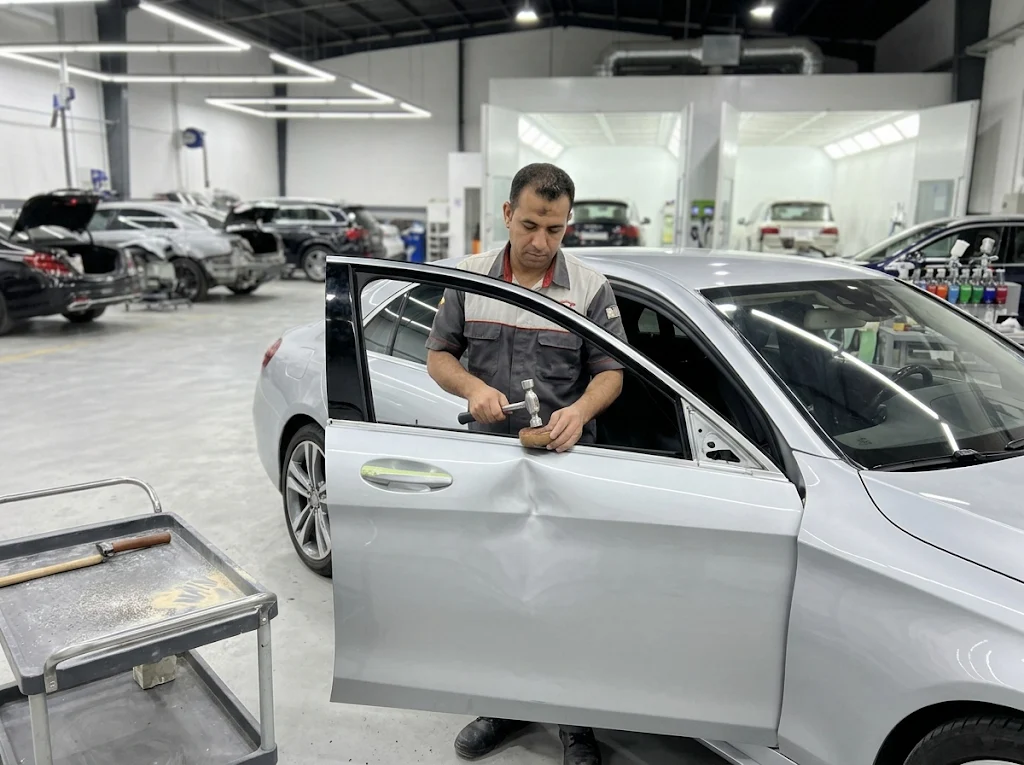
What does car denting and painting mean?
Across the UAE, “denting and painting” is what most drivers call panel repair. It describes one job with two halves: the metal is brought back to its original shape, and the paint over it is rebuilt so the repair disappears.
The two halves depend on each other. A beautifully painted panel still looks wrong if the metal underneath is wavy, and a perfectly shaped panel is not finished until its paint is sealed again. Doing both, in the right order and under one roof, is what makes the result invisible.
Every job moves through five stages, and each has to be right before the next one starts:
- Shaping. Pushing, pulling and shrinking the metal until the panel's lines and curves match the undamaged side of the car.
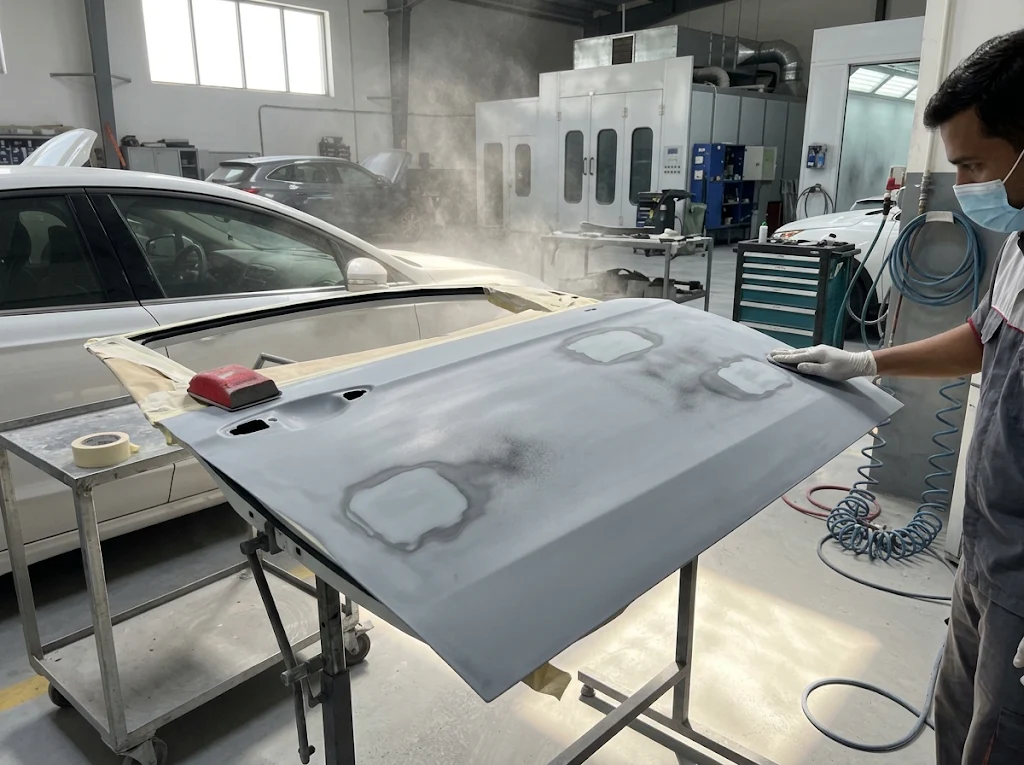
- Filling. A thin skim of body filler smooths marks too fine for tools, then is sanded flat.
- Priming. Primer seals the bare metal and filler and gives the colour a stable, even base.
- Painting. Base colour mixed to your factory paint code, then clear coat for gloss and UV protection.
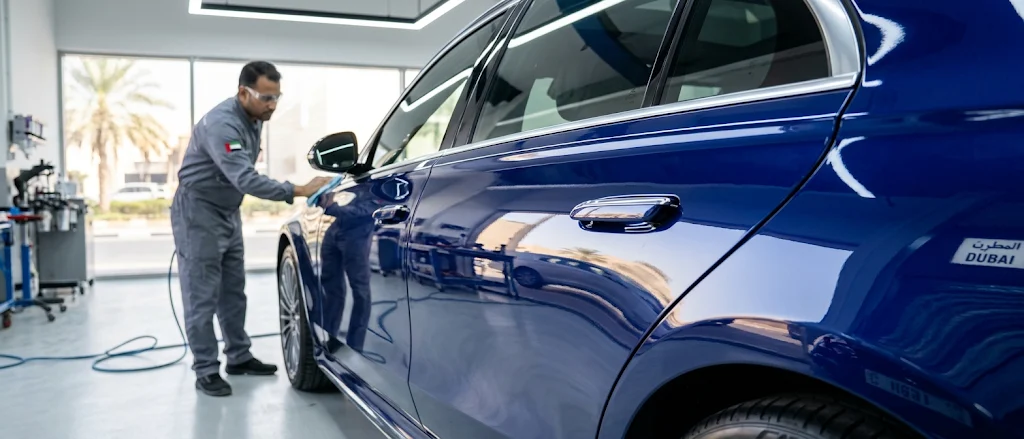
- Blending. Fading the new colour into the neighbouring panels so the eye cannot find an edge.
In Dubai the order matters even more. Bare metal left exposed in humid coastal air starts to corrode quickly, and paint that has not fully cured struggles once the panel sits in summer sun.
Denting: how are dents pulled, shaped and smoothed?
Car body denting starts with reading the damage, not hitting it. We look at where the impact landed, which way the metal moved and whether it stretched, because stretched metal behaves very differently from metal that has simply been pushed in.
Where there is access from behind, the panel is worked out gradually with hammers and dollies. Where there is not, as on double-skinned sills and boot lids, the dent is pulled from the outside with welded pull studs, which are ground away afterwards.
Stretched metal is shrunk with controlled heat so the panel stops oil-canning, or popping in and out when pressed. Only when the shape is right does filler go on, kept to a thin skim, never a thick layer hiding poor metalwork.
The filled area is block-sanded, checked under angled light and primed. A guide coat dusted over the primer exposes any low spots before a drop of colour is mixed.
Not sure what your dent needs?
Send two or three daylight photos and we will tell you which repair fits and how long it should take.
Painting: primer, base colour, clear coat and blending
Paint on a modern car is a layered system, and a proper repair rebuilds every layer, not just the colour you see. Each coat does a different job, which is why a skipped or rushed coat shows up later as fading, peeling or a patch that never quite matches.
Blending is the step most often skipped, and it decides whether a repair is truly invisible. A door painted edge to edge in fresh colour can look a shade apart from a wing that has spent five years outdoors in the Dubai sun.
Primer
Primer bonds to bare metal and filler, blocks moisture and fills fine sanding marks. It is sanded smooth before colour goes on, because any texture left in the primer shows straight through the finish.
Base colour
Mixed from your car's factory paint code, then checked on a spray-out test card against the car in daylight. Metallic and pearl colours are judged from several angles, as the flake can look right head-on and wrong from the side.
Clear coat
The clear layer gives gloss, depth and resistance to UV, sand and bird droppings. It is applied in full coats, cured in a controlled booth, then machine-finished so its texture matches the factory paint.
Blending
New colour is faded into the neighbouring panel so there is no hard line where old paint meets new. Factory paint on a car in Dubai has usually aged slightly in the sun, and blending hides that difference.
Common denting and painting jobs: doors, wings, bonnets, boots, bumpers
Most cars that reach us arrive with the same handful of problems: car park knocks, kerb and pillar contact, and low-speed bumps in traffic. The times below assume the panel is repaired rather than replaced, and we confirm them once we have seen your photos.
Door dents
The most common job in Dubai, usually from a neighbouring door in tight mall parking. A single door with a shaped dent, filler and paint typically takes two to three working days, including blending into the next panel.
Front wing dents
Front wings take hits from bollards, pillars and other bumpers. Because a wing bolts on, it can come off for better access behind the dent. Expect two to three working days, with the door and bonnet edge blended.
Bonnet dents
Bonnets are large, flat and catch the light, so even slight waviness shows. Hail, falling objects and stone strikes are typical causes. Allow two to four working days, as the whole bonnet is normally painted.
Boot lid dents
Boot lids pick up reversing knocks and dents from being pushed shut in one spot. Many are double-skinned, which limits access from behind, so pulling tools do more of the work. Allow two to three working days.
Bumper dents
Plastic bumpers deform rather than dent. We reshape them with controlled heat, repair splits from behind, then use a flexible primer so the paint moves with the plastic. Most bumpers take one to two working days, with parking sensors masked or removed.
Rear quarter panel dents
Unlike doors and wings, a rear quarter is welded into the body and cannot simply be swapped, so repair is the normal route. These dents often run into the wheel arch and take three to four working days.
Our denting and painting process
Every car dent and paint repair we take on follows the same six steps, whether it is one creased door or three panels scraped along a car park pillar. Nothing moves to the next step until the last one passes inspection.
Photos and first assessment
You WhatsApp photos of the damage in daylight, one close up and one from a few metres back. We tell you whether it looks like a paintless repair or a denting and painting job, and give an honest time frame.
Inspection and paint code
At the workshop we confirm the damage by hand and under light, check paint depth with a gauge to spot any earlier repairs, and read your car's factory paint code so the colour mix starts from the right formula.
Shaping the metal
Trim, handles and sensors near the repair are removed or masked. The dent is then pushed, pulled or shrunk back into shape and checked against the matching panel on the other side of the car.
Filling and priming
A thin skim of filler smooths what tools cannot, then is block-sanded flat. Primer goes on, a guide coat reveals any low spots, and the panel is sanded again until it is completely true.
Colour, clear coat and blending
We spray a test card and compare it with the car before painting. Base colour and clear coat are applied in a booth, blended into the adjacent panels, then cured under controlled heat.
Finishing and handover
Once cured, the clear coat is machine-finished to match the factory texture. Parts are refitted, panel gaps checked, and you inspect the car with us in daylight before it leaves the workshop.
Photos first, then a clear plan
WhatsApp a photo of the damage and we will reply with the right method and an honest time frame.
Is your dent a paintless repair or a denting and painting job?
Not every dent needs paint. Paintless dent repair, or PDR, massages the metal back from behind and leaves the factory paint untouched, and when it suits the damage it is the better choice. The deciding question is whether the paint has survived.
If the paint is cracked, chipped, scratched through to primer, or so stretched it would crack as the metal moves back, it has to be rebuilt. The same applies to sharp creases and dents on panel edges, where the metal is too stiff to massage out cleanly.
| Dent size | Paint damaged? | Right method | Typical time |
|---|---|---|---|
| Small ding | No | Paintless dent repair | A few hours, often same day |
| Palm-size dent | No | Paintless repair if the metal is not stretched; denting and painting if it is | Same day without paint; 2–3 working days with paint |
| Crease | Often, along the crease line | Denting and painting | 2–3 working days |
| Large dent | Often stretched or cracked | Denting and painting, sometimes across two panels | 3–5 working days |
| Dent with cracked paint | Yes | Denting and painting | 2–3 working days per panel |
Good to know: original factory paint is worth keeping. If your paint is intact and the dent is shallow, repainting the panel adds work without improving the result, and we will tell you so. Equally, a paintless repair over cracked paint leaves the crack in place, where moisture and sand get in.
Denting and painting near me: why the workshop's process matters more than distance
Typing “denting painting near me” into a map brings up the closest garages first, which makes sense when you are driving around with a dented door. But a short drive only saves minutes, while a poorly prepared repair can show for years.
When you compare results for “denting and painting shop Dubai”, the listings look much the same. The real differences sit under the paint, and Dubai's climate exposes them faster than most places:
- UV and heat. Summer air passes 45°C and dark panels in direct sun get far hotter. Filler that was not fully cured, or clear coat applied too thin, can sink, dull or reveal the repair outline within months.
- Sand. Fine dust settles on wet paint in an open workshop and sets into the clear coat as specks. Painting and curing in a closed booth keeps the finish clean.
- Humidity. Coastal humidity reaches bare metal quickly. A panel left stripped overnight before priming invites corrosion that later lifts the new paint from underneath.
- Tight parking. Mall and residential car parks mean doors, wings and bumper corners take repeated knocks, so a repair needs the full layer build of factory paint, not a thin colour-only respray.
So rather than asking who is closest, ask how a workshop shapes the metal, how thick its filler goes, whether it blends, and where it paints and cures. A good workshop will answer all four without hesitation, and we are happy to walk you through ours.
Scope note: what this service covers
This page covers cosmetic dents and the paint over them: the panel damage left by car park knocks, low-speed bumps, hail and kerb or pillar contact. We have repaired cars in Dubai since 2015 and work directly with car owners.
We focus on paint and bodywork only. If photos or inspection show damage that goes beyond the panel and its paint, we will tell you plainly before any work starts rather than paint over it.
Aluminium panels, very large dents and heavily stretched metal are assessed case by case, as some are better replaced than repaired. Timings on this page are typical for a single panel and are confirmed once we have seen the car.
Frequently Asked Questions About Denting and Painting
What is denting and painting?
Denting and painting is the combined repair for a dented panel whose paint is damaged. The metal is shaped back to its original line, smoothed with a thin skim of filler, primed, then painted in base colour and clear coat. Finally the new paint is blended into the neighbouring panels so the repair cannot be seen.
How long does denting and painting take?
A single panel, such as a door or wing, usually takes two to three working days. Bumpers are often quicker at one to two days, while large dents or jobs across several panels can take three to five. Much of that time is primer and paint curing, which is not something we rush.
Will the dent be completely invisible?
That is the aim, and on most panels it is the result. The shape is checked against the other side of the car, the colour is matched on a test card, and the paint is blended into adjacent panels. Very old, heavily faded paint is harder to match exactly, and we will tell you before starting if that applies.
Can a creased panel be fixed?
Usually, yes. A crease stretches and stiffens the metal along its line, so it rarely comes out with paintless methods alone. We pull and shrink the crease, smooth the remaining marks with a thin skim of filler, then prime and paint. Creases that cross a panel edge or body line take longer, as those lines must be rebuilt precisely.
Do you need to paint the whole panel?
Not always. Base colour is often applied only around the repaired area, then faded out. Clear coat, however, normally covers the full panel so there is no visible edge in the gloss. On flat, light-catching panels such as bonnets and roofs, painting the whole panel usually gives the cleanest result.
When is paintless dent repair enough?
Paintless dent repair is enough when the paint is completely intact and the metal is not badly stretched or creased. Small dings, shallow car park dents and many hail marks fall into this group. If your photos show that, we will tell you a paintless repair is the better fix and keep your factory paint.
Will the new paint match?
We start from your car's factory paint code, then spray a test card and compare it with the car in daylight, because factory paint varies slightly between batches and ages in the sun. Adjustments are made before the car is painted, and the colour is blended into neighbouring panels so any tiny difference disappears.
Can you fix dents on aluminium panels?
Yes, in many cases. Aluminium is used on the bonnets, wings and boot lids of many premium cars, and it needs a different approach from steel: less heat, more patience and tools kept apart from steel work to avoid corrosion. Some aluminium dents that have badly stretched the metal are better replaced, and we will say so.
Do you repair bumpers with dents?
Yes. Plastic bumpers are reshaped with controlled heat, and splits are repaired from behind before any filler goes on. A flexible primer lets the paint move with the plastic instead of cracking. Parking sensors are masked or removed during painting. Most dented bumpers take one to two working days.
How do I send photos for assessment?
Tap the WhatsApp button on this page and send two or three photos taken in daylight: one close to the damage, one from a few metres back, and one at an angle so the reflection shows the dent's shape. Add your car's make, model and colour, and we will reply with the right method and a time frame.
Car Denting and Painting in Dubai, Done Properly
Whether it is a door ding from a mall car park or a crease along a wing, the repair starts with a few clear photos. Send them over and we will reply with the right method and an honest time frame.