
Best Land Rover Body Shop in Dubai
Searching for the best Land Rover body shop in Dubai usually starts after a scraped sill, a faded roof or a crumpled rear bumper. We repair and refinish the Defender 90, 110 and 130, the Discovery and the Discovery Sport, with proper aluminium technique and colour work matched to the factory finish.
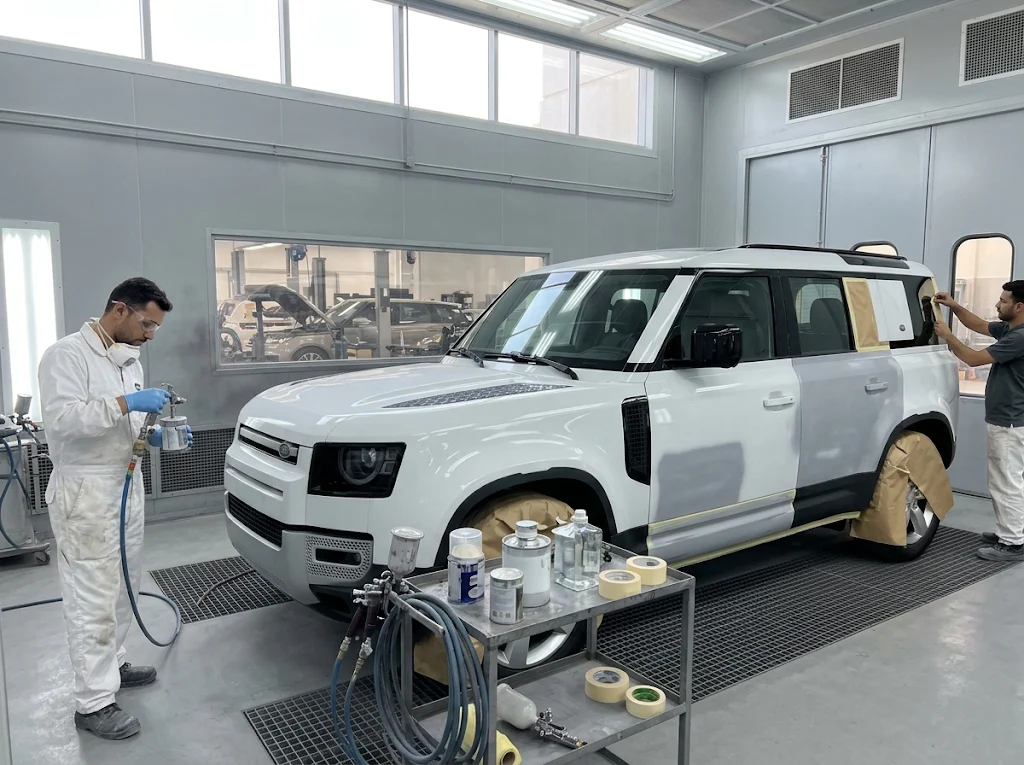
Why do Land Rover owners need a specialist paint and body shop in Dubai?
Defender and Discovery owners search differently from Range Rover owners, and their cars arrive with different damage. A Range Rover usually comes in with a kerbed bumper from a mall car park. A Defender comes in with sand-scoured sills, a scuffed gear carrier and a roof that has spent several summers facing the sun.
These are working shapes. Flat, upright panels show every ripple and shade change, contrast roofs turn colour matching into a two-colour job, and the current Defender and Discovery are built largely from aluminium, which behaves very differently from steel when it is repaired.
We have worked as an independent paint and body workshop in Dubai since 2015. We are not a franchise workshop and do not claim manufacturer approval. What we offer is focused paint and bodywork on these models, from a scuffed bumper corner to a full side after a dune trip.
- Upright panels. Flat doors and a flat bonnet reflect light like a mirror, so filler and colour blends must be invisible from every angle.
- Two-tone finishes. Contrast roofs and black cladding give every repair two edges to manage, not one.
- Aluminium construction. Repairs need dedicated tools and a clean area to avoid contamination and corrosion.
- Desert use. Lower panels must be repaired to cope with sand and stones, not only to look right in the car park.
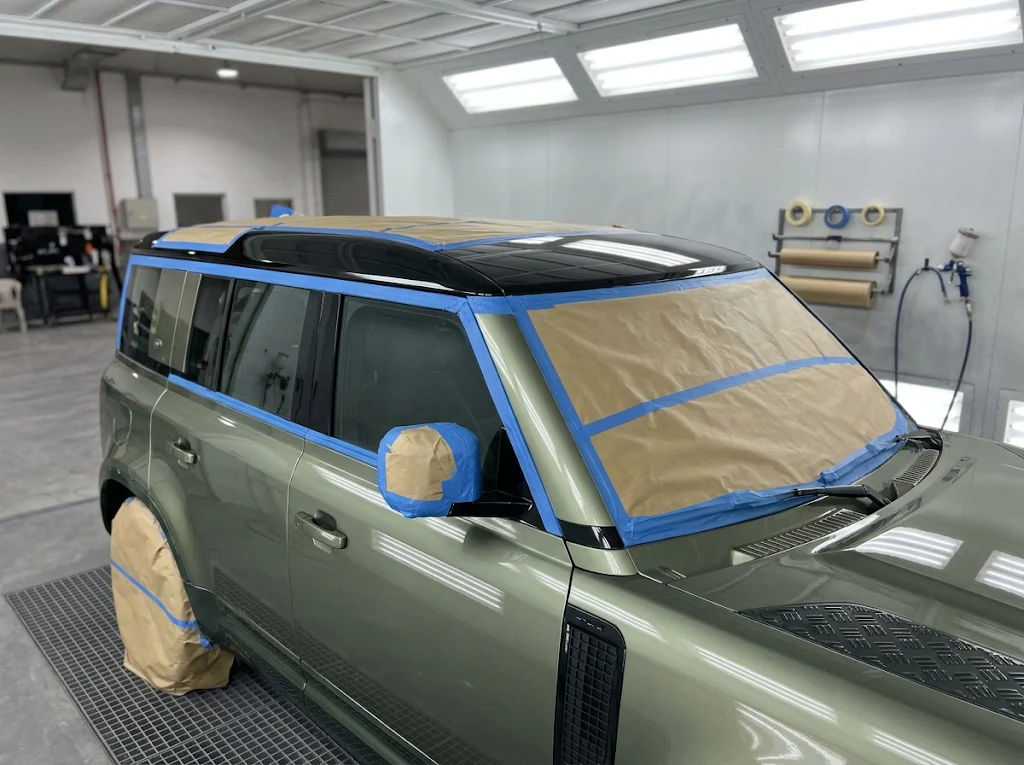
Land Rover models we repair
We work on the current Defender and Discovery family and on earlier generations. Each body has its own construction, trim layout and weak spots, so every repair plan starts with knowing exactly which car is in the workshop.
Defender 90
The short-wheelbase, three-door Defender. Its wide doors and compact rear make door edges, rear quarters and the side-hinged tailgate the most common repairs, along with contrast roof refinishing on cars ordered with one.
Defender 110
The five-door Defender most owners choose. Its long, flat sides mean a scrape along the sills or rear doors needs careful blending across several panels so the repaired area cannot be picked out in sunlight.
Defender 130
The longest Defender, with an extended body behind the rear wheels. That extra length is exposed on steep dune exits and car park ramps, so rear bumper and lower quarter damage is typical.
Discovery
The seven-seat Discovery has an aluminium-intensive body, a large one-piece tailgate and an offset rear number plate recess. Rear bumper corners, tailgate edges and front wings take most of the knocks in daily Dubai driving.
Discovery Sport
The compact family Land Rover, built mainly from steel. Bumper scuffs, door dings and scratched rear quarters are the usual repairs, often on cars that rarely leave tarmac but live in busy school and mall car parks.
Earlier generations
We also repair earlier Defenders with their riveted aluminium panels, and the Discovery 3 and 4. Older paint needs extra care with matching, because years of Dubai sun have shifted the original colour.
Send a photo before you book
Two clear photos on WhatsApp let us tell you what the repair involves and how long it will take.
The Defender's exposed design and what it means for repairs
The current Defender was designed to look tough, and much of that look comes from parts that sit proud of the body. They are the first things to touch a rock, a bollard or another car, and each needs its own repair approach.
Side-mounted gear carrier
The optional gear carrier sits on the rear side panel. Scrapes on the carrier are refinished off the car, while the body panel behind it is checked for pressure marks and cracked paint around the mounting points.
Wheel-arch cladding
The black textured arch mouldings shield the paint but are often gouged themselves. We remove the cladding before painting the wing behind it, so the colour runs neatly beneath its edge instead of stopping at a visible line. Damaged cladding is refinished in a textured trim finish or replaced, depending on depth.
Contrast roof
Many Defenders leave the factory with a black or white contrast roof that meets the body colour along the pillars. Refinishing it means masking a long, crisp colour break that has to sit exactly on the factory line.
Spare wheel and tailgate
The full-size spare hangs on a side-hinged tailgate, so its weight and the tyre's edges put stress on the panel. Scuffs around the wheel mount, chipped tailgate edges and loading dents are part of normal Defender life.
None of these areas is difficult on its own. The skill lies in handling them together without leaving a car that looks repaired.
Common Land Rover damage in Dubai
Desert driving, summer heat and tight car parks produce a recognisable pattern of damage on these cars. These are the repairs Defender and Discovery owners bring to us most.
- Lower-door and sill scrapes from dunes. When a Defender drops off a dune crest or slides into a rut, sills and lower doors drag across sand and rock, leaving streaks of bare aluminium that must be sealed and refinished promptly.
- Tailgate and spare wheel scuffs. The side-hinged tailgate carries a heavy spare, so its edges, the wheel mount area and the lower corners collect chips, dents and rubbing marks.
- Contrast roof fade. Heat and UV dull black roofs towards grey and turn white ones chalky, while roof racks add rubbing marks along the edges.
- Discovery rear bumper damage. Reversing knocks and car park scrapes crack corners and split mounting tabs. It is the Land Rover bumper repair Dubai owners ask us about most often.
- Door scratches. Not every Land Rover scratch repair Dubai owners bring us needs a respray. Clear coat scratches are machine finished out, while deeper ones that reach colour or primer are repaired and refinished.
The table below summarises how we approach each exposed area.
| Defender/Discovery area | Typical damage | Our approach |
|---|---|---|
| Contrast roof | UV fade, roof rack rubbing, stone chips on the leading edge | Read the roof paint code, mask the pillar break, refinish the full roof in the correct gloss and cure in the booth |
| Bonnet | Stone chips, sun fade, bird lime etching on the flat surface | Paint-depth check, chip and etch repair, full-panel refinish blended into the wings where needed |
| Wheel-arch cladding | Gouges, scuffs and loose clips after off-road use | Remove before painting the wing, refinish in textured trim finish or replace, refit on new clips |
| Sills | Sand and rock scrapes, bare metal streaks, dents from rock contact | Aluminium-safe dent work, thin filler, anti-chip primer and refinish blended into the doors |
| Side-hinged tailgate | Spare wheel scuffs, edge chips, loading dents, cracking near the hinges | Remove the spare and fittings, repair the panel, refinish edges and blend to the rear quarters |
| Front bumper | Lower lip scrapes, cracked tabs, scuffs around sensors and camera | Plastic repair, sensors masked or removed, controlled paint thickness over sensor zones |
Our Land Rover repair process
Every repair follows the same six steps, whether it is a scuffed bumper corner or a full side of a Defender 130.
Send photos on WhatsApp
Send a wide photo of the car and two or three close-ups of the damage, with the model and year. We reply with what the repair involves, which panels are affected and a realistic timeline, before you drive anywhere.
Inspect and read the paint code
At the workshop we read the factory paint code, check paint depth across the damaged and neighbouring panels, and confirm whether each panel is aluminium, steel or plastic. That decides the tools and materials for the job.
Strip and mask
Cladding, badges, gear carrier fittings and the spare wheel come off wherever they touch the repair. Parking sensors, cameras and radar areas are masked or removed so nothing is painted over or damaged during preparation.
Repair the panel
Dents are worked out with aluminium-specific tools in a clean area, cracked plastic is repaired from behind, and filler is kept thin. Bare metal is primed promptly so the surface stays clean, sealed and sound.
Match and paint
We spray test cards and compare them to the car in daylight before painting. Colour is blended into adjacent panels so the eye cannot find an edge, then clear coat is applied and cured under controlled booth conditions.
Finish and check
Once cured, the surface is machine finished to match the factory texture and gloss. We refit trim, check panel gaps, test sensors and cameras, and inspect the car in daylight before handing it back.
Back from the dunes with damage?
WhatsApp a few photos today and we will tell you what needs doing and how long your Land Rover will be off the road.
Can aluminium Defender and Discovery bodies be repaired properly?
Yes, when the damage is within what a panel can take and the work is done the right way. The current Defender and the Discovery use aluminium-intensive bodies, which keep weight down but change how damage behaves and how it has to be fixed.
Aluminium has less memory than steel. It stretches rather than springing back, it hardens as it is worked, and it can crack if it is pushed too far or too cold. Dents are shaped back gradually, often with controlled warmth, using hammers, dollies and pullers kept only for aluminium.
Contamination is the other risk. Steel dust from grinding on another car can embed in aluminium and cause corrosion under the paint months later. That is why our aluminium work happens in a clean area with its own abrasives and tools.
After shaping, the panel is primed with a product suited to aluminium before filler and colour, so adhesion holds through Dubai summers. The result is a panel that looks and lasts like the original, not one that blisters at the edges a year later.
Honest advice: Not every aluminium panel should be repaired. Deep creases, torn edges and damage across structural sections are usually better replaced, and we will tell you so at the photo stage rather than attempt a repair that will not last.
How do you choose the best Land Rover body shop?
A few questions will quickly tell you whether a workshop is set up for a Defender or Discovery. Use this checklist to judge any Land Rover body shop Dubai owners are considering, including ours.
- Do they ask for your paint code and model year? Matching by eye alone is guesswork, especially with older, sun-faded paint.
- Do they handle aluminium properly? Ask how they keep aluminium and steel work apart. A clear answer about dedicated tools and a clean area is a good sign.
- Do they use spray-out test cards? Testing the mixed colour against your car before painting prevents mismatched panels.
- Do they blend into neighbouring panels? On long Defender sides, painting a single door to its edges usually leaves a visible step in colour.
- Do they remove trim rather than mask around it? Cladding, badges and lights should come off, or tape lines will show.
- Do they mention sensors and cameras? Parking sensors and radar need correct paint thickness and testing after refitting.
- Do they tell you what they will not do? A workshop that says plainly when a panel needs replacing, or when a job falls outside its work, is one you can trust.
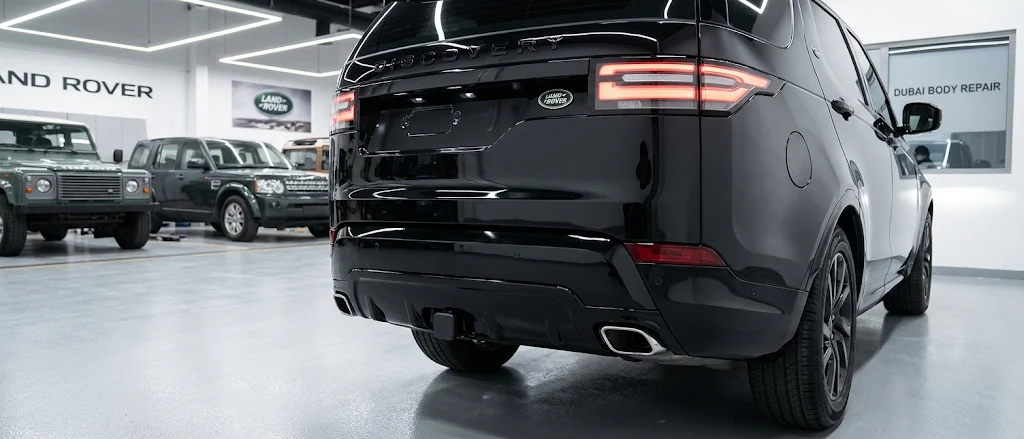
Paint and bodywork only: what is outside our scope
Many workshops list Land Rover painting Dubai-wide as one service among dozens. We treat paint and bodywork as the whole job, so our attention stays on panels, colour and finish.
We do not carry out mechanical repairs or servicing, and we do not apply coatings or wraps. Our workshop focuses on paint and bodywork only.
We also work directly with car owners and do not handle insurance claims. You deal with us, see the car before and after, and know exactly who did the work.
If a repair reveals something outside our scope, such as a broken sensor or a fault behind a panel, we tell you straight away so it can be seen to before the car goes back on the road.
Frequently Asked Questions About Land Rover Body Repair
Do you repair the new Defender 90, 110 and 130?
Yes. We repair and refinish all three body lengths of the current Defender, from bumper scuffs and door dents to full side refinishing after off-road damage. Each version has its own trim, cladding and tailgate fittings, so we confirm the exact model and year from your photos before planning the repair.
Can you repaint a Defender contrast roof?
Yes. We read the roof's paint code, mask the colour break along the pillars and refinish the whole roof so there is no visible join. We also match the gloss level to the factory finish. Faded contrast roofs are a common Defender job in Dubai, because the roof takes the full force of the summer sun.
Do you repair Discovery and Discovery Sport bodywork?
Yes. We repair bumpers, doors, wings, tailgates and roofs on both models. The Discovery has a largely aluminium body, while the Discovery Sport is built mainly from steel, so we confirm the panel material before choosing tools and primers. Rear bumper and tailgate damage is the most frequent Discovery repair we handle.
Can you fix desert damage on Defender sills and doors?
Yes. Sand and rock scrapes on sills and lower doors are repaired by shaping out any dents, sealing bare metal promptly, then priming, refinishing and blending into the panels above. We add an anti-chip primer layer on lower areas so the new finish copes with future off-road use as well as the original.
Can the Defender's aluminium panels be repaired?
In most cases, yes. Dents and scrapes on aluminium panels are repaired with dedicated tools, gradual shaping and controlled warmth in a clean area, away from steel dust. Deep creases, tears or damage across structural sections are usually better replaced, and we tell you that honestly after seeing photos or the car.
How long does a Land Rover bumper or panel repair take?
A single bumper or panel usually takes two to four working days, including preparation, painting and curing. Several panels, a full contrast roof or aluminium dent work take longer. We give you a realistic timeline once we have seen photos, and confirm it after inspecting the car, so you can plan around the time it is with us.
Will the parking sensors and cameras on my Land Rover work after painting?
Yes. Parking sensors, cameras and radar areas are removed or masked during preparation, and we keep paint thickness over sensor zones within normal limits so they read correctly. Every system is tested after refitting. If a camera or radar ever needs electronic calibration, we tell you before work starts so it can be arranged with the right specialist.
Can you match my Land Rover's factory colour exactly?
We start from your factory paint code, then spray test cards and compare them to the car in daylight, adjusting the mix until it matches. Because Dubai sun changes paint over time, the match is made to your car as it is today, and the new colour is blended into adjacent panels so no edge is visible.
Will a repair affect my Land Rover's resale value?
A well-matched, properly prepared repair should not hurt resale value, while visible damage or poor previous repairs usually do. Buyers and inspectors often check paint depth and colour consistency, so we keep film thickness close to factory levels and blend carefully. We can also share before and after photos of the work for your records.
How do I get my Land Rover assessed?
WhatsApp us a wide photo of your Land Rover and two or three close-ups of the damage, with the model and year. We reply with what the repair involves and how long it will take. If you prefer, call the workshop on +971 52 791 4606 and we will arrange a time for you to bring the car in.
The best Land Rover body shop in Dubai for Defender and Discovery owners
Send us a few photos of your Defender or Discovery and tell us what happened. We will explain the repair, the timeline and what to expect, so you can decide with the full picture.